11 June 2010

Probing the Fence Line

If you want to attack a facility that is protected by a fence festooned with intrusion sensors, the first thing you want to do is to nullify the sensors. You could try to disable them, but that would only give the guards inside warning of your attack. The best thing is to train the guards to ignore the intrusion sensors, at least for long enough to give you time to establish a position of tactical advantage. So, you cut loose some of the tumbleweeds around the fence. You might entice some of the local animals to interact with the fence. Anything to generate a random sequence of false alarms until the guards get tired of checking out each one. Then you can risk a little jiggling as you get inside.

That lesson from a retired U.S. Navy Seal is what I thought of when I learned of the Israeli encounter with the "Freedom Flotilla" sent by Hamas sympathizers to challenge Israel's blockade of Gaza. Send a ship full of food and aid, no contraband, and a few rowdies ready to make trouble. When the Israelis board the ship to inspect it, mob them, beat them with clubs and sticks (some say metal rods). Now clubs, sticks, and rods are not "deadly weapons" in the same way guns are, but you can kill a man by beating him with clubs, rods, and sticks. You can kill a man by beating him with your fists, if he doesn't fight back. Given that they were being beaten by a crowd that vastly outnumbered them, it isn't surprising that the Israeli commandos started shooting their guns. It was that or be killed. One might fault the Israelis for letting themselves get into a situation where they would have to use such deadly force, but it would have taken a lot more ships and commandos to control the situation without such intensity of force.

In any case, the result was a made for television and blogosphere media event. Mean powerful Israelis bullying innocent people trying to help starving Palestinians in Gaza. And a successful probing attack, to be followed by many others, to break Israel's will to continue the blockade. This will then be followed by another season of rocket attacks on Israel from Gaza, once the Palestinians get rockets shipped from (indirectly or otherwise) Iran. Then another round of Israeli soldiers on the ground in the Gaza strip, followed by another blockade.

It would be nice if the cycle could be broken. Heck, it might even help if Israel could hire a Public Relations firm as good as those working for the Palestinians. There is plenty of material for them. To start, note that the term Palestina was coined by the Roman Empire so that it could make a better case for removing the Judeans (Jews) from their land, which previously had been called Judea.

Here is a video telling the other side of the story:

Maritime Martyrs from CJHS on Vimeo.


And there has also been violence on the border between the US and Mexico. A boy threw rocks at a US Border Patrol Agent, who then shot the boy. There is some discussion that the boy might have been acting as a decoy for smugglers, but who knows? In effect it was another successful probing attack on the fence line. But there is also talk on the right in America about making the border with Mexico harder and shallower - by putting up a guarded wall.

I would prefer making the border softer and deeper - by creating a joint US-Mexican governmental authority to manage the transient population of Mexicans who want to enter the US to do temporary or seasonal work. To make sure they are well treated and reasonably paid. And to vet them so as to keep the criminals out.

We may also have to legalize marijuana just to knock the profit out of the business. We will then get a taste of what China went through when Western interests forced it to legalize the opium trade. But it would be a setback for Mexican drug cartels. And both the Mexican and US governments need them to be set back.

30 May 2010

Working Girl

Here is Ruby (foreground) with her mother and father, at her breeder's house. Mom (aka "Milk Bar") is nursing Ruby's nine new brothers and sisters, while Ruby and Dad have been hitting the dog show circuit. In the past three weekends, Ruby has taken one third place, two second places, and two firsts. She's back home tonight, resting from her labors. Actually, dogs seem to do a lot of resting, no matter what.

Today is Memorial Day, on which we remember those patriots who have refreshed the well-spring of liberty with their blood. Let us also remember those survivors who left pieces of themselves (physical, emotional, or both) on the battlefield. You don't have to go it alone. To all of you who have returned, thank you for serving, and welcome back.

We now have pictures of both our fathers in WWII Army uniforms. My father was on the American side, my wife's on the German. Let the old wounds heal. The rest of what I have to say is in VCBC's Military Chapel.

11 May 2010

Top Ten Anti-Israel Lies

The Simon Wiesenthal Center is hosting these here. They're pretty good, so I thought I'd pass them along.

As Josh Billings used to say, "It ain't ignorance that hurts folks. It's all the things they know that ain't so."

08 May 2010

What a Little Bird Told me about SETI

Dr. Paul Foldes, of blessed memory, once told me this joke:

A small bird was starving one winter. It was so cold, he couldn't fly any more, and he fell to the road. Just then a horse-cart passed over him, and the horse dropped a huge load of dung on him. The dung warmed the bird, and the seeds in it fed him. Soon he was feeling so cheerful he started to hop around and sing. The commotion attracted the attention of a passing wolf, who pulled the bird out of the dung and ate him.

This story has three lessons. First, the one who puts you in deep doo-doo is not necessarily your enemy. Second, the one who pulls you out of deep doo-doo is not necessarily your friend. And third, if you're full of doo-doo, don't draw attention to yourself.

I keep the last lesson in mind when thinking about SETI, the Search for Extra-Terrestrial Intelligence in the Universe. SETI proceeds by combing the universe for radio signals that meet certain statistical criteria for being non-random and non-repetitive - in other words, not of natural origin. But suppose that some ET were out there looking for us. For a long time, say 5 billion years, there would be nothing. Then a faint glimmer of radio signals starting around a century ago. Then analog television shows from about 60 years ago. But this year, television has gone digital - which looks more like random noise to those statistical algorithms. We are going quiet, going out of radio frequency existence after only a century or so. Odds are very slim that any ET would be looking our way during that brief period of time. Which means that odds are we won't be found.

And that is a very comforting thought. Consider the energy it takes for interstellar travel. Let's say that an alien civilization had a spaceship weighing 10 metric tonnes, that it could accelerate to 99% the speed of light. If such a thing experienced brake failure (accidentally or otherwise) it would hit whatever was in its path with an energy of 5x10²⁰ Joules, or 100,000 megatons TNT equivalent. That's more than enough to smash a planet. And we wouldn't even see it coming, because the light from it would be moving barely ahead of it. By the time we detected it, it would be too late think much about it, much less to to do anything about it.

Maybe that's why SETI hasn't found anything. Maybe all those ETs out there have done the same simple calculation that I've just done, and have decided not to draw attention to themselves. Our digital revolution is making us appear to go radio quiet. Let us continue, for in the grand scheme of interstellar society, we may be the little bird.

07 May 2010

Conspiracies and Wars

Normally, I'm not one for conspiracy theories, but yesterday's stock market gyration is just too tempting. Consider how much money could be made by executing a few thousand buy orders at the bottom of such a rapid plunge and rebound. Could yesterday's 999 point drop in the Dow be the work of a few rogue traders? A self-funded "probing" cyber attack by a government preparing to paralyze the West should the need arise to do so?

It also looks like the recent attempt to car-bomb Times Square is the result of a long-time association between the family of the alleged bomber, Faisal Shahzad, and militant leaders of the Taliban and al-Qaeda. He had become a naturalized US citizen, making him a very desirable target for recruitment by such groups.

On the other hand, back in the 1960's there was a conspiracy by the US government to cover-up certain embarrassing details of the Vietnam War then in progress by abusing the system of classifying information (in ways that are now illegal). Daniel Ellsberg blew the cover by leaking thousands of pages of classified documents (now known as the Pentagon Papers) to the press. Ellsberg was saved from prison by the Nixon Administration's botching of the case against him, while committing crimes of its own ( the Watergate break-in). Still, I was offended by the way Ellsberg described his crimes and his pot-smoking so proudly during a City Arts and Lectures interview on NPR. Civil disobedience is a serious thing. Maybe Ellsberg would be more serious about it if he had served even a tenth of the 115 year sentence for which he was eligible. I suppose I should thank him, because efforts by him and people like him ended the draft just before I would have been forced to decide between going to Vietnam as a soldier or to prison as a draft resister. I never considered Canada. As I said, civil disobedience is a serious thing. Doing it for the right reasons and taking the consequences is patriotic. Evading the consequences is not. Ellsberg talks as if he's forgotten that.

Today I have friends and colleagues whose careers include one or more tours of duty in Vietnam. I now realize that in a way, we won. The time our war effort bought the Pacific Rim economies to develop, and the pain it caused the North Vietnamese, made it impossible for one Asian government after another to fall like dominoes to Communism. So, for those who did what they saw as their duty, thank you for serving and welcome home.

I remember especially one paratrooper who had become a reservist after his tour in Vietnam. He was the only one on campus. I met him while he was in uniform, folding his parachute before his weekend training exercise. He had a lot of guts to try to make it at such a left-leaning school. We all should have been more welcoming to him. After all, he did what he did for us.

21 April 2010

My Brother's Keeper

A cornerstone of Obamacare is the sharing of risk, which means sharing the cost of covering that risk. In order to insure the uninsured and the otherwise uninsurable, we must compel young, healthy people to buy health insurance. So far, so good - as long as you don't think the Federal government's compelling people to buy something infringes on their liberty.

But then, young healthy people can jeopardize their life and health by engaging in risk-taking behavior, which could turn them from being a source of funds into being a very expensive sink. So, if your risky behavior puts my financial well-being in jeopardy, I might want to compel you to wear a helmet whenever you bicycle. I might want to make it illegal for you to smoke - anything. Maybe I want to monitor your drug and alcohol intake. Maybe I need to compel you to take all your medications, exactly as your doctor prescribed. Perhaps I should consider making you take anger management classes to keep you from hurting yourself or other people whose health care I may be required to subsidize. If I am my brother's keeper, I want some say over how well my brother takes care of himself.

You get the idea. There is an unavoidable trade-off between taking care of each other -  sharing risk - and curtailing individual freedom of action. At one extreme we have Libertarianism - which maximizes liberty by letting everyone go to hell in their own handbasket if they can get one, and at the other we have Woody Allen's dictator from Bananas proclaiming that everyone must wear underwear, and "Underwear will be worn on the outside, so we can check."

So, maybe you don't object to my keeping you from smoking, drinking too much alcohol, or abusing drugs. But maybe I need to prevent you from engaging in promiscuous sexual activity, because that puts the whole society at risk for Sexually Transmitted Diseases (STDs). Nah. That would never happen. I mean, if Social Conservatives ever come to power again, they would just dismantle Obamacare. They wouldn't just change it to suit their agenda, would they?

But then, the whole idea behind Obamacare is that the changes it makes should be very hard to reverse. This is supposed to be a permanent change to do permanent good. Right?

26 March 2010

Everyday Treasures

Every time I shave, I remember the uncle who taught me how. As I let the water get hot, I remember how Mother would wipe our faces with a cold washcloth before she sent us off to school. When I put on socks, standing, balancing on one foot at a time, I remember my mother remarking that my father did it the same way. When I shine my shoes, I remember Dad teaching me the way to do it. I even use his wooden shoeshine box and the brushes he used to apply and buff the polish.

These old memories associated with ordinary things are my everyday treasures. We are indeed such stuff as dreams are made on. We are also the stuff of memory.

Perhaps my favorite memento is a faded and bedraggled toy Bunny Rabbit. Over half a century ago when I was almost four, our family dog chewed his nose, and ate his torso entirely, including most of his stuffing. I was distraught. BR was my constant companion, my Imaginary Friend. Fortunately, my father's mother was visiting us. Grandma took needle and thread from Mother's sewing basket, and a Banlon sock from Dad, and after hours of surgery assisted by my older sister, she restored to me a functional, if diminished Bunny Rabbit.

Not long after that, Bunny Rabbit disappeared. He was lost, I was told. In reality, my parents couldn't stand the idea of sending their son off to Kindergarten carrying the shabby thing everywhere, like Linus carrying his blanket in the comic strip Peanuts.

Though it was my first loss, I got over it soon enough. But years later, when I was visiting from another state after landing my first real job, Mom showed me where she had been keeping him in a trunk in the basement. I took him with me. I don't handle him or even look at him much. He lies in a glass-fronted bookcase, slouching companionably against a favorite childhood toy of my wife. My dad's old bamboo and ivory slide rule lies at his feet. There he is, partly an old toy, and partly my mother's thread, my father's sock, my grandmother's handiwork, and my first dog's spit. He's a treasure like no other. Maybe I'll leave him to my last dog to finish the job my first one started.

01 March 2010

Answering the Hierophant

Ever since 1997, Patrick Mooney has posted The Hierophant's Proselytizer Questionnaire as a challenge to any Christian who tries to proselytize him. The deal is that the proselytizer must answer the Hierophant's 150-odd questions first. If Patrick likes the answers, he may get in touch.

A year ago, I decided to work through the questionnaire, even though I don't feel called to proselytize, so much as to apologize - as in apologetics, explaining Christianity to those interested. I wanted to use it to work through my own beliefs. My own health issues, my mother's death, and my grieving process all acted to delay my completing the project, but now, for any willing reader's comments, here it is.

23 February 2010

A Marginal Jew, continued

Well, I did it. I finished Volume Four: Law and Love of the massive A Marginal Jew: Rethinking the Historical Jesus, by John P. Meier. My updated review of all four volumes is here.

21 February 2010

Doggie PMS

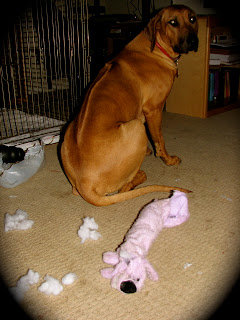
Since every male dog for miles around knows it, you may as well know it, too. Ruby is in season for her first time. Mostly, she is mellow and cuddly. But every now and then, she grabs her latest chew-toy and rips the stuffing out of it. Here she is amid the extracted fluff and squeakers of a now flaccid pink dachshund doll. To her left lie shards of a plastic water jug.

Other than that, she believes that she wears a perfectly tailored and tres chic fur coat. It simply won't do to cover it with a diaper. The little spots on the floor and on her bedding - well - clean them up, that's what humans are for.

Her biggest hardship is doing without those daily off-lead romps with other dogs in the local parks. Maybe some playtime in a fenced yard with our neighbors' bitch will help relieve the tension.

Now for some lunch. She's back on her chow again, and weighed in this week at a svelte 87 pounds.

In the meantime, here is a video of what she really lives for:

14 February 2010

MTS

MTS stands for Member of Technical Staff. I first heard it at the old Bell Labs, where I was an MTS and an MTS-Supervisor. Since then, the label has propagated to tens of companies where scientists and engineers (aka S&Es) develop hardware and software for new products and services. It is now industrial "best practice," to call industrial scientists and engineers MTSs instead of by their actual specialties, such as plasma physicist, solid state physicist, electrical engineer, nuclear engineer, inorganic chemist, mathematician, spectroscopist, etc. The bland designation "MTS" gives the illusion that it is easy to compare the contributions of these uniquely trained and experienced individuals across disciplines. That way one can have a uniform compensation policy across disciplines, which simplifies salary administration and avoids litigation.

The risk of such an industry best practice is that management can actually come to believe that it represents some kind of ground truth. At the old Bell Labs, my management actually told me that any MTS should be able to do any other MTS's job. As a corollary, they also told me that a good manager ought to be able to manage anything, no matter what it is.

It should be obvious that neither of these statements are true. And if they weren't true at the old Bell Labs (which is now defunct) it is even less true at the US National Laboratories, particularly those involved in maintaining the US Nuclear Weapons Stockpile. And yet, the US National Labs are adopting the MTS designation, and abandoning job classification by discipline. Why? Because the Labs have been privatized. They are no longer run by the University of California as a service to the nation and under contract to the US Department of Energy. They are run by Limited Liability Corporations, of which the University of California and Bechtel Corporation are senior partners.

You can't blame the Obama Administration for this. The delusion that everything will run better if it's run like a business is a Republican delusion, and this one was foisted on the National Labs under the Bush Administration. The first problem with this is that nobody, especially nobody in Congress, thought through the implications of privatizing the National Labs. As a result, the Labs lost many millions of dollars in federal, state, and local tax exemptions, and incurred millions of dollars in additional management fees - all of which resulted in thousands of layoffs, because the Lab's budgets were held flat. The second, longer term problem is that Research and Development (R&D) is not a business. It is a cost of doing business, and most businesses minimize that cost by not doing R&D. Or at least by doing only D (development) and not R (Research). This is because the only one thing in the Universe more inefficient than Research is ignorance.

Now the bean-counters, the efficiency experts, are forcing the National Labs to conform to industry best practices by adopting the MTS designation for all members of its scientific and engineering workforce. At first, this will be harmless. But, by making the members of the National Lab workforce look superficially like everybody else's workforce, it may enable the delusion that they can be managed by "more professional" executives from outside corporations who don't really understand what all those MTSs do. Who believe they don't have to understand, because "a good manager can manage anything." And then, with that lack of understanding, they may begin to mixmaster the workforce whenever they need to move people around to save jobs, because "any MTS should be able to do any MTS's job." It took about 20 years for that mentality to destroy Bell Labs. The risk is that the same mentality may be allowed to creep into the National Labs, which are part of what maintains our National Security in terms of both defense and energy.

Now the National Labs may fare better than Bell Labs, because Bell Labs was funded by a competitive business (once the old AT&T was broken up in order to settle a lawsuit by MCI). And as I said, industry survives competition by doing as little research as possible. The National Labs are funded by the US taxpayers, as represented by their President and their Congress. That should give us all confidence, right?

Oh, well. I might as well close with some levity. Imagine these words sung to the tune of the "M.T.A Song," (better known as "Charlie on the MTA," written in 1948 by Jaqueline Steiner and Bess Hawes, and made famous by the Kingston Trio's recording of it in 1959:

The MTS Song

Let me tell you the story
Of a man named Charlie

Who was put to a fateful test.

He used to be a chemist,
A very good chemist
'Till they made him an MTS.

Charlie lost his uniqueness

When bean-counters from Bechtel
Forced him to make a change

When he balked his boss told him,

"They need you in Lasers.

Your transfer has been arranged."

Chorus:
Did he ever return,
No he never returned
And his fate is still unlearn'd
He may lurk forever
'neath the beams of Lasers
He's the man who never returned.

Now all day long

Charlie sits in his office

Crying, "What will become of me?

I wanna be a chemist
But now they tell me

To do Plasma Spectroscopy!"

Chorus

Charlie's colleagues go down

To the diagnostics station

Every day at quarter past two
And in between shots
They hand Charlie a sandwich

As the data come pourin' through.

Chorus

Now employees of LLNS,

Don't you think it's a scandal

That our titles are meaningless

Get our uniqueness back!
Go talk to George Miller!

Charlie's a chemist, not an MTS.

Chorus:
Or else he'll never return,

No he'll never return
And his fate will be unlearned

He may lurk forever 
'neath the beams of Lasers.

He's the man who never returned.

He's the man who never returned.

He's the man who never returned.


See also: Leviathan, Inc.

08 February 2010

Conservative Falsehoods

After trashing the liberals, it's only fair to bash the conservatives. And it's so easy. Conservatives come in several flavors:

  1. Religious/Social: The ones we hear from most, because they're the loudest. They harp on abortion and homosexuality. They want to ban the practice of the former, and the expression of the latter. Contrary to liberal prejudice, they have something to contribute on these questions.

    Not long after permitting abortions, we began engaging in human embryonic cell research. This opened a hole in our law by creating a class of human beings who are pre-personal, i.e., not yet persons, endowed by their Creator with inalienable rights, such as the right to life. But they are not just clumps of cells. They are not just things. Since treating them as if they are mere things de-humanizes humanity, we had best decide what rights they do have, and protect them, in order to protect ourselves from ourselves.

    With the partial liberation of homosexuals to just be themselves, we have seen some raunchy/transgressive behavior, and a muddying of the concept of marriage. Listen, friends, if it's rude for Britney Spears to show hers, it's rude for you to show yours, whether or not you self-identify as straight. As for marriage, I propose the following compromise. A binary union between two unrelated consenting adults that is performed by a civil authority is a civil union. The same union performed as a religious ceremony by a recognized religious authority is a marriage. Civil unions and marriages should have all the same rights and privileges before the law. It's just that marriage is a sacrament and civil union is not. That leaves the question of gay marriage with the religious institutions, and gets the government out of it.

  2. Fiscal: They think the government spends too much. If they would shut up and deliver on fiscal restraint in government, I'd agree with them. As things now stand, however, I'd like to choke a few fiscal conservatives on wads of cash.

  3. Small government/Libertarian: They think the that whatever powers are not explicitly granted by the Constitution to the federal government are reserved for the States of the People. In this, they are absolutely right, and the current drift toward a freer interpretation of the Constitution is nothing less than the drift toward a soft totalitarianism that De Tocqueville warned us about. Ultimately our government is founded on a system of rules that limit its behavior. If we don't like the rules, we should go through a disciplined process to change them (the Constitutional Amendment process). Our current practice of behaving as if (or judicially declaring that) the rules don't mean what they say puts us all in peril.

    Small Government Libertarians seem to have no influence whatever over the Republican Party.

  4. National Security: They think that keeping Americans safe and secure from foreign attack and or domination is the primary mission of our government. While it is true that until peace breaks out on the entire earth you must either get comfortable with your own military or get comfortable with someone else's, it is only the fourth of six co-equal missions of the federal government:
    ...to form a more perfect Union, establish Justice, insure domestic Tranquility, provide for the common defence, promote the general Welfare, and secure the Blessings of Liberty to ourselves and our Posterity.
    Nevertheless, the idea that National Security is a conservative issue indicates a failure of liberals, not a success of conservatives. In point of fact, defense research usually fares better under Democratic administrations than under Republican administrations.

  5. Pro-human rights and American Exceptionalism: These folks think America's unique mission in the world is to further liberty (aka human rights) at home and abroad. They want to engage China on its human rights violations of Tibet, stop the persecution of Christians in the horn of Africa, stop female genital mutilation in countries that practice it, and on and on and on. So do many liberals. In truth, this has no business being an orientation that distinguishes conservatives from liberals.

The upshot of this is that the Republicans are not really a single party. They are a bag of cats, whom their leadership has slapped. The fallout of that cat fight is the tea party movement.

Henry Kissinger once said of the Iran-Iraq war that it was a pity that both sides couldn't lose. That's how I feel about liberals vs conservatives, Republicans vs Democrats.

What I want is a smaller federal government that is more competently run, that minds its business instead of ours, and is less cavalier with our money, our liberty, and our lives. Beyond that, I want it to adapt to change (societal and environmental) prudently. And most of all, I want it to represent us. The current practice of legislation being written by 24,000 naive Congressional staffers poorly supervised by Congress-persons from gerrymandered districts, and not read or understood by anyone is not representative government. To me, our Congress is hemorrhaging legitimacy.

07 February 2010

Liberal Prejudice

Gerard Alexander, an associate professor of politics at the University of Virginia has an opinion piece in today's New York Post entitled, "Why are liberals so condescending?" In it he describes four basic attitudes liberals have toward conservatives. Conservatives must be

  1. Stupid. They just don't know how to think critically and reasonably.
  2. Liars. They know their ideas are wrong, but they crassly manipulate large fractions of the voting public out of nothing more than a lust for power. When they succeed it is by "vast right-wing conspiracy techniques of media manipulation.
  3. Racists. They seek to maintain white privilege in an increasingly diverse society.
  4. Cowards. They fear change and therefore seek to stop progress.

Prof. Alexander goes on to explore and debunk all of these misconceptions in the light of the last forty years of American history. He laments that these attitudes on the part of those now called liberals or progressives prevents genuine dialog with conservatives.

But he doesn't call these attitudes by their correct name. Prejudice. Overwhelmingly, liberals whom I know are prejudiced. That's why I parted company with them. Or should I say, they parted company with me.

Entertaining doubt of one's opinions is good for both science and religion. If we are going to have meaningful bipartisanship, then we're going to have to try it in politics.

04 February 2010

Change You Can Believe In

Michael Barone has published this article claiming that the Intergovernmental Panel on Climate Change (IPCC) has been putting out junk science. Well, it has. It has also published real science, some of which has been based on careful work done by people I know. He also states that Anthropogenic Global Warming (AGW) has become a religion, complete with Original Sin (carbon emissions) and the sale of Indulgences (Carbon Credits). That is also true, and that part of the reason why the junk science was allowed in.

Now, I'm not a climate scientist, but I am a physicist, and a former theoretical type who has become sort of Swiss Army Knife kind of generalist. I'm also religious, specifically Christian. With these two attributes in my background, I have these observations to make.

First of all, the climate is changing. It has always changed, and it always will will. See The Long Summer: How Climate Changed Civilization, by Brian Fagan. Briefly, the world has been getting warmer ever since the last Ice Age ended some 12,000 years ago. This warming has been punctuated by some impressive cold (and dry) snaps, one of which turned the former Fertile Crescent into a desert. But the long-term trend has been ever upward. The short name for this is "good weather," as it has contributed to the development of agriculture and with it the origin and growth of complex civilization.

Second, atmospheric carbon dioxide has been a lagging indicator in all the previous upticks in global warming. As the world warms, CO2 is outgassed from the oceans and the tundra, possibly forming a positive feedback loop which strengthens the warming trend. If the current increase in CO2 is a leading indicator, it will be the first time. On the other hand, this could indeed be the case, because a significant fraction of the CO2 has been injected into the atmosphere by humans burning fossilized carbon. We know this, because we can do carbon-14 radioisotopic dating of the carbon in atmospheric CO2.

Third, we now have coupled Ocean-Atmosphere General Circulation Models (OAGCMs) that, together with their component models for clouds, dust, natural biological effects, etc., mimic the long term historical climate pattern pretty well, and produce predictions that are more-or-less consistent with one another, and look like Earth, not Mars or Venus. That is to say, modern climate predictions are no longer based on how quickly or slowly the climate models diverge from what looks like Earth. The predictions are reasonable, but noisy.

Fourth, the noise. One major source of noise is the ENSO, or El Niño Southern Oscillation in the Pacific Ocean, which is dumping so much rain on the US right now. The uptick, El Niño, actually temporarily warms the entire globe a bit. Conversely, the downtick, La Niña, cools it a bit. So, you have to look for trends in noisy data, and match them to trends in noisy predictions. It's a little tricky, especially if you don't have a deep understanding of the statistical techniques available. And even for decent scientists, it's easy to make a mistake and draw a wrong conclusion. This is what some of the critics of the IGPP have done. As they say, "Mistakes were made," on both sides of the climate debate.

Fifth, the ersatz religion. As G. K. Chesterton said,

When people stop believing in God, they don’t believe in nothing — they believe in anything.

Here I think Barone is on point. AGW has become a matter of perverted faith for some people, and therefore, they become disinclined to scrutinize anything that supports their agenda. They are willing to pass on whatever sounds like it agrees with them, in order to stir the people to repentance and reform before Nature visits catastrophe upon them. But stating something as fact without checking it out is what Harry Frankfurt calls bullshit. And it does real damage to the study of climate change, its causes, its effects, and what we can do about it, because it obscures the real science that has been and is being done.

Sixth, what to do about it. The AGW religionists want to put clamps on the global capitalism by Cap and Trade policies that would create markets in carbon emissions offsets. There are precedents for this other than the sale of Indulgences by the pre-Reformation Church. All governments sell or lease the Radio-Frequency RF Spectrum to broadcasters and telecom companies, for example. But the goal of Cap and Trade is to force (not foster) innovation to generate energy in other ways than burning fossil fuels.

We could skip the whip of Cap and Trade, and jump to its goal: innovation. We could try to figure out how to foster innovation to develop and investment to implement alternative energy technologies. Under Cap and Trade, we will have to do that anyway, but why not cut to the chase, and skip the bad economic consequences? After all, we have another incentive to stop burning fossil fuel: most of the world's known remaining petroleum reserves are under control of petro-dictatorships that are ultimately hostile to the peace of the whole world, not just that of the United States. Given that there are real and credible indications that anthropogenic carbon emissions may be accelerating global warming faster than humans can accomodate without an increase in warfare (and we don't need that, do we?) developing alternatives (including nuclear energy) to carbon burning energy is the prudent thing to do.

Finally, there is real religion, and its temptations. In order to guard against idolatrous faith, one must embrace doubt of one's own opinions no matter how cherished. That is why I'm reading the latest volume of Fr. John P. Meier's A Marginal Jew: Re-thinking the Historical Jesus. Look for me to expand my review of the first three volumes when I'm done.

Note Added: See climatologist John R. Cristy's view of the climategate scandal at the University of East Anglia.

02 February 2010

About the US Military

When I was doing Stephen Ministry some years ago, I met a man I'll call Russ.

This is his story.

01 February 2010

Obama Gets It

This past Friday, January 29, the Wall Street Journal carried an opinion piece by Vice President Joe Biden entitled, "The President's Nuclear Vision." Mr. Biden states,

We will spend what is necessary to maintain the safety, security, and effectiveness of our [nuclear] weapons.

He goes on to propose increasing the budget for the US nuclear weapons program to enable a credible and rigorous effort to maintain the safety, security, and reliability of our nuclear arsenal, and acknowledges that as the number of nuclear weapons decreases, their reliability becomes more important, not less.

Wow. President Obama gets it. And he is a big enough man to make an issue his own, that his opposition considers theirs. Now that's bipartisanship.

31 January 2010

Are UFOs for Real?

We meet the most interesting people while out walking the dog. An internationally known concert pianist. A marriage and family therapist. A lifestyle and weight management consultant. And today, a cabinet maker who put me onto this video of Mercury astronaut Gordon Cooper recounting his UFO sightings, while in the air, on the ground, and in space (the voiceover narrator is Jonathan Frakes):


Gordo is no spring chicken. Are we seeing the effect of a few TIAs (transient ischemic attacks, aka mini-strokes) which may have altered his memories, or did he decide to embellish his experiences a bit for what seems to be a paid interview, or is he for real?

First of all, the psychiatrist Robert Jay Lifton studied UFO experiencers, and found them to be psychologically normal, and truthful. They are not nuts, and they are not lying. But just because you are sane and telling what you believe to be the truth doesn't mean you can't be mistaken. Second, there are people who have made reasonable arguments that even if Extra-terrestrial Intelligent beings exist, they would probably have so little in common with us that neither we nor they would notice each other, and even if we did, we would have nothing in common we could talk about. As in this article, for example.

But if UFOs really do exist, and if they actually buzz us from time to time, how in the Universe did they find us, and why would they bother? Then again, we have explored every place on earth we could get to, just because we could. And some of us now go to the ends of the earth as tourists just to see the wildlife.

All that, however, leaves the question of why so much secrecy? How could all the governments of the earth manage to collude successfully to keep official records of such encounters from the global public? And why would they continue to bother? The most parsimonious explanation is that there is nothing to hide.

Still, I wonder. If I look up at the sky and smile, will I wind up on Google Earth, or some more distant image archive?

28 January 2010

Being Nerd

HBO is about to release a biopic about Temple Grandin. Dr. Grandin, despite being autistic, is a professor of Animal Science at Colorado State University. In a pre-movie interview, she mentioned that autism is a spectrum disorder, which means that there are various manifestations of it, some more severe, some less. Among the less severe is Asperger's Syndrome, and among the least severe is the nerdy, geeky, kid.

That rang a bell. I've always had to insist that my wife just tell me what she wants or what she is thinking. "I'm a scientist, not a mind reader," I always say. It turns out that my other scientist friends say the same thing to their spouses. Now I realize that there must be all sorts of subtle cues that most people pick up, but I don't. Oh well, being a nerd has its limitations, but it keeps me in a job with good pay and benefits.

When I mentioned this realization to my wife, the nearly licensed psychologist, she said she had known about it for a long time. She just didn't want to be the one to tell me. Gee. I feel lucky to have gotten married at all. Thank God that some women like nerds, and are willing to do what it takes to get them to realize they are interested.

27 January 2010

State of the Union

I wish to request a small correction to President Obama's State of the Union address. He was mistaken when he said,
Now, even as we prosecute two wars, we're also confronting perhaps the greatest danger to the American people -– the threat of nuclear weapons.
We are not prosecuting two wars. We are fighting in two theaters of operation of one war, the War against Islamofacism. Calling it the "Global War on Terror" was always a bad idea. But not calling it anything at all is worse. This is a war, not a police action. Now it is true that we must find cheaper and more effective ways to fight it than large-scale maneuver warfare employing massive numbers of troops with the attendant massive expenditures. But we (the entire world, not just the US) must fight and win it. For more analysis, click here.

I want to praise the President for this:
But to create more of these clean energy jobs, we need more production, more efficiency, more incentives. And that means building a new generation of safe, clean nuclear power plants in this country.
Fantastic. Maybe he will undo the Clinton Administration's decision to defund development of the Integral Fast Reactor.

Finally, I want to state that I think bipartisanship means that major bills should have significant content from both parties, not just a token amendment to buy a vote or two from the opposing side. That would require our representatives from the two parties to trust each other, but so far, they have proven unworthy of each other's trust, which has caused them to lose our trust. Maybe they can start fixing that by showing a little civility to each other.

25 January 2010

Evil Nonsense, Absolute Truth

Now that I can get my hand on the keyboard more comfortably after shoulder surgery (to fix the rotator cuff I tore when I fell off my recumbent bicycle) I can let off a little existential steam. I'd like to talk about ideas that are running loose in academia and our wider culture that are pernicious nonsense.

Number one: There is no such thing as Absolute Reality.

Of course there is! Here's a little piece of it: One plus one equals two. As long as we are talking about the integers one and two, it is, has always been, and will always be absolutely true. Granted, my example is only a little piece of Absolute Truth, but it is a representative beginning of mathematics and mathematical logic, which together form a language that - if you follow its rules - guarantees that the statements you make are absolutely true. There are limits to how much truth you can discover with mathematics, which means there are limits to the bits of Absolute Truth that can be known by unaided Reason. But you can know quite a bit.

Number two: Absolute Reality may exist but it is unknowable.

Well, some of it is knowable. Think of one plus one equals two.

Number three: Absolute Physical Reality may exist, but Modern Science says it is unknowable.

It's knowable well enough. No matter how much you believe otherwise, you will fall down when you step off a cliff unless you are attached to some sort of aircraft. Relativity and quantum physics merely illustrate that while geometrical objects in mathematics are collections of infinite numbers of points, geometrical objects in physics are not. We have yet to discover the categories of thought and mathematics that appropriately describe physics at small scales (of space-time and energy-momentum).

Number four: Reality is socially constructed. You can change reality by changing people's perception of reality.

"The world is what I want it to be, or what I make it to be," is the thought of the infantile narcissist. The world is what it is, whether we like it or not. Physical reality (including economic reality) is what it is. Only social reality is socially constructed, and only partly so at that. Physical and economic reality place severe constraints on social (which includes political) reality. If the constraints are ignored, whole societies can collapse. And the collapse can involve suffering and death for large numbers of people.

It is this last idea, that is so pernicious. And because the other three are often used to justify the fourth, they are pernicious, too.

Of course, as a Christian, I don't think it either necessary or possible for us to know all there is to know about Absolute Reality. Rather, I take comfort in the belief that Absolute Reality knows us.

On the other hand, there are many of my fellow Christians who say that everything we need to know about Absolute Reality is in the Bible, literally interpreted.

I dispute both parts of that conjecture. First if everything we needed to know about Absolute Reality were in the Bible, we would not have to live and die. God could just recite it to us without our having to take on our present mortal forms. There is an experiential component to Absolute Reality which must be lived. Second, if you interpret the Bible literally, then the firmament that is referred to in Genesis is a translation of a Hebrew word that means a piece of metal that God hammered into a thin, but gigantic sheet. We've been going up to the sky for a hundred years now. The only sheet metal around is the space junk we've left up there.

The Bible is a doorway to the Absolute Reality/Truth that can only be experienced through Faith. But if there is no Truth in the Reader, then only the Truth can help the Reader. Read, know the Truth, and the Truth will set you free.

15 January 2010

Geek and Proud

OK, there's a tragedy in Haiti caused by its buildings, which were built without regard for earthquake safety. Thank you Haitian government for failing to set and enforce the ground rules that would have kept people alive and unhurt. The Haitian government didn't go far enough to protect its people.

At the same time, the US government is perhaps going too far, enacting a health insurance reform bill that doesn't reform health care, and may be too costly. But a pack of wild Senators crazed with the momentum of the moment, oblivious of the concept that the Senate is supposed to be the more deliberative body in Congress, is railroading it through.

And the world stock markets are heading up the central peak of a W-shaped economic recovery.

I could rag on about the bad news, but a friend pointed me to this, and it's just too geek-chic for words:


The European Center for Nuclear Research (CERN is the French abbreviation) has built the Large Hadron Collider, with which it is looking to validate or invalidate the long-reigning Standard Model of particle physics and cosmology.

We've come a long way from when a single man with two pieces of glass could shake the foundations of a Church that had idolatrously conflated its opinions of the Creation with the worship of the Creator!

04 January 2010

Old Bombs and Bathrooms

While listening to NPR a couple of months ago, I heard an Indian diplomat casually state that is was common knowledge abroad that the US is working on "fourth generation" nuclear weapons. This bit of misinformation went unchallenged. I certainly didn't call in, because most information regarding the state of US nuclear weapons is classified, and I didn't want to jeopardize my day job, much less go to prison. Then our old upstairs bathroom provided a metaphor.

The sink began leaking. Fortunately the leak was slow and intermittent. It appeared to be coming from the body of the reproduction antique faucet I had installed 11 years ago. My body did not relish being cramped up under the sink again, so this time, I called a plumber.

After close inspection , the plumber told us that the leak could not be repaired. The entire faucet body and (considering the way things are bundled these days) faucet control levers would have to be replaced. Would we like to stop by the shop and order a set?

At this point my wife remembered that the toilet leaked, too. It was just a slow drip where the flush valve didn't seat properly, and would only take a minute to fix, right? The plumber was more than glad to replace the flush valve, but he didn't have the identical part. This wasn't surprising since the toilet is a genuine antique. It has been in the house for 80 years. So, he put in a newer, more complicated valve arrangement and left for his next job. By that evening, the toilet was running badly.

Now with respect to nuclear weapons, the plan to replace an aging part with a new part is called a "Life Extension Program," or LEP. The problem with an LEP is that sometimes the same old technology is no longer available. Our plumber, for instance, did an LEP on our old toilet, but he used a non-identical, newer technology part. Does that make it a "fourth generation" toilet?

In any case, the Toilet Life Extension Program 1 (TLEP1) was a failure, because the young plumber did not inspect the old flush valve seat carefully enough. If he had done so, he would have noticed that the seat had corroded, and would therefore also need to be replaced (TLEP2).

But the flush valve seat is part of a J-bend that doesn't exist on modern toilets. You can imagine why. Our antique toilet has a porcelain reservoir tank that hangs on the wall. The metal J-bend pipe connects it to the pedestal (the business end) which is about three inches away from the wall. The lower end of the J-Bend is joined to the pedestal by a brass spud, a rubber spud gasket, and a spud nut. If the spud nut is too loose, water floods onto the floor. If the spud nut is too tight, the porcelain cracks and the entire toilet must be replaced. Since they don't make toilets like ours anymore (too leak prone and too hard to fix), we would have to get a modern, Reliable Replacement Toilet (RRT). The RRT would work just like the old toilet, but the porcelain tank would sit directly on top of a porcelain extension of the pedestal, with just a rubber gasket connecting them. Same flush, without the J-bend. Again, does that make it a "fourth generation" toilet?

The plumber was skeptical about further TLEPs. The failure of TLEP1 led him to diagnose the need for TLEP2, but it might be that the parts were no longer available or were very costly. Most people in our position would just buy an RRT, he advised. (I use the term RRT, because it is similar to RRW, or Reliable Replacement Warhead, a name which must have been chosen by someone with no background in Public Relations.)

We were adamant. We have an antique house, and for esthetic reasons we want to maintain it as a kind of museum to the period in which it was built. Find the parts, we said.

Four hundred dollars and two sets of parts later, the toilet was still not fixed. The young plumber, unfamiliar with the old technology, bent one of the old replacement parts out of round. We requested an old plumber, who eventually did a successful TLEP2. The new flush valve assembly still leaked, though, until I replaced it with an old-style flush valve I found in an old-style hardware store. Call it TLEP2 Mod 1. And for all that, we couldn't keep the technology frozen in time. The toilet looks the same on the outside, but it has one or two new technology parts inside.

Ultimately our adventure fixing our old toilet took longer (a month), was more complicated (three separate, sequential efforts), and cost a lot more than replacing the thing with a similar-looking alternative, which would have taken a few days (mostly ordering and shipping).

So it is with the unfortunately named Reliable Replacement Warhead. Ultimately, it would be cheaper and more reliable to modernize the US nuclear weapons stockpile, than to keep it on life support with repeated LEPs. Modernization also has the advantages that we could be sure of the availability of parts, and the familiarity of young technicians with the basic technology.

We could do nothing: no LEPs and no RRWs. But that would risk the stockpile eventually becoming unreliable ("turning to green cheese," as they say in the business). That's a bad idea, given the state of the world, and given that all the other nuclear weapons states are modernizing their arsenals. I think it better to modernize the stockpile so that we can disarm by intent as geopolitical conditions warrant, rather than disarm by default at a date uncertain.

Anyway, after all the difficulty, delay, and cost of the TLEPs, I ended up doing the RRF (Reliable Replacement Faucet - remember there was no LEP for this problem) myself. But this brings up one more subject. The reason that we could go without a bathroom for a month - that we did not have to relieve ourselves at the neighbors', or dig a privy in the backyard - is that we have a downstairs bathroom which served as a backup. By analogy, we should always maintain enough different types of warheads and delivery systems in the US nuclear weapons stockpile, and enough spares, such that we can still provide deterrence to our adversaries and assurance to our allies even if some portion of the stockpile were to become unreliable for a while.

25 December 2009

Merry Christmas!

On this Feast of the Nativity of our Lord, we decided to give Ruby a smoked ham bone from a genuine German Wursthaus. Here she accepts it with enthusiasm, and then chews it with her eyes closed. May this Christmas be as satisfying to you and all those you hold dear. May joy this intense and complete be yours in the new year.

Here is more canine holiday cheer. And our Christmas message from PostSermon.

20 December 2009

Outdoor Furniture

After more than a dozen years of this type of abuse from two Great Danes, a German Shorthaired Pointer, and now Ruby, our 80+ pound Rhodesian Ridgeback, our Brown Jordan patio furniture is holding up very well. The tempered glass table top has held twice her weight, and provides a unique vantage point to observe squirrels in the neighbor's yard. And tasty though all that plastic webbing appears, it has so far not tempted toothy scrutiny. May it continue even so.

18 December 2009

Puppy Update


Ruby has been a busy girl. She won two ribbons in her class (6-9 months), and has taken other trophies as well. The welcome mat that used to lie outside our kitchen door entrance has been reduced to shreds of recycled tire rubber. This mat survived the combined efforts of Nessa (Great Dane) and Pongo (German Shorthaired Pointer), but somehow Ruby, at a svelte 80 pounds now, has been able to do what her predecessors' combined 230 pounds could not. It seems that she has a special talent for disassembly. Search out the weakest spot and just keep working it until it gives. Then on the next weakest spot. And so on, in a canine combination of intellectual exercise and oral gratification. As if her daily 1-2 hour walks/playtimes with other dogs just left her so keyed up that she needed a post-peripatetic chomp and chill. As if digging three-foot wide craters in the yard to tear out tree roots was not entirely satisfying (they're like sticks from the woodpile but much more challenging and flavorful).


She also triumphed over the pink hedgehog by biting off its nose. Now its formerly vicious squeak has been reduced to a whimper (because so much air escapes through the nose hole instead of the squeaker), and Ruby can munch it in peace. Its days as a recognizable object are numbered.

I'm off in search of a more robust doormat this weekend, plus a new cord for the lamp in the living-room. Fortunately for her, she pulled the plug out of the electrical outlet before she chewed it off.

Whenever I watch Ruby play with other dogs I'm reminded of this song:


She's such a party animal.

08 November 2009

Contempt for Congress, Among Others

The US House of Representatives has passed a healthcare reform bill. If it makes it through the Senate unaltered, it will, according to Betsy McCaughey writing in this weekend's Wall Street Journal, require employers and insurers to offer only "qualified" plans which can differ only in premiums and co-pays, not on what is or is not covered. The message is that the Democrats think you're too stupid to choose between competing plans if the choice is any more complicated than just dollars and cents. Their solution is to make health insurance a commodity. According to the Congressional Budget Office, your premiums will go up, not down, and the bill doesn't specify what a qualified plan is or is not. Otherwise translated as "we'll stick it to you later."

There is more, much more, to this 2,000 page piece of trash, but this much is clear. The Democrats are enemies of your economic liberty because they think you're too stupid to handle it. They just want to make life simpler for you. This doesn't mean that the Republicans are friends of liberty. No way. They want to take away your sexual liberty, because they think you're too irresponsible to handle it. And they've taken away a good bit of your privacy because they think you're too cowardly to accept the risk of terrorist attacks that real privacy brings.

In other words, if you care about your liberty, you might as well lump the parties together and call them Republicrats. Neither of them are comfortable trying to govern a free people who take responsibility for themselves and live with the consequences of their choices, wise or unwise. They are well-intentioned, but their desire to take care of you, to keep you safe from either yourself or from others, does not make them your friends.

Of course, the Republicrat discomfort with liberty (which compels them to seek the power to limit liberty) is only one reason why our legislation has been so outrageous of late. The other is that Congress as arrogated unto itself so much power and authority that it can no longer effectively handle its workload. As a result the Congressional Staff now numbers around 24,000. About 11,000 of them work of individual Senators and Congresspersons. They tend to be just out of college or law school, and they view their positions as stepping stones to real careers somewhere else. In other words, they have little or no real world experience, and they are not going to have to deal with the consequences of what they write as legislation. And what they write are not so much like laws as they are like bad term papers - there may be flashes of brilliance in somewhere in them, but they're too long and too full of other junk to find them out.

If I could wave a magic wand, I'd make Congress delegate a significant amount of their power back to the states so that local problems could get local solutions, and to the federal regulatory agencies so that more time and thought and less politics might go into those curbs on our liberty that we must accept in order to have a functioning republic. Then I'd cut back the Congressional staff, and turn more of their positions into careers rather than transitional jobs, so that there would be some experience and historical memory among the staff.

I'm not sure what I'd do about the bribery. It is clearly more widespread than Congress and exists at higher levels than I had thought. How else did some of New York City's wealthiest employers get H1N1 vaccine ahead of the city's medical clinics?

Of course, I could be wrong. Both the American Medical Association and the American Association of Retired Persons have endorsed this monstrosity of a health care bill. Or maybe big businesses and big lobbies aren't necessarily friends of liberty either. After all, the main reason that we are trying to reform the health care system in the first place is that we are currently at the mercy of big businesses (our insurers and employers) and big lobbies that look out for their interests rather than ours.

23 October 2009

Health Care Reform is Easy

Health Care Reform could be really easy. Did you know that every health care provider is free to charge anyone whatever they can get away with? The result is that every insurance company negotiates with every provider organization (hospital, medical group, etc.) over what price they are going to pay for what procedures and services. A big insurer can command low prices, so the costs get shifted to the smaller insurers. The result is that some insurers will pay $1500 for an appendectomy at a given hospital, while others pay $13,000. No wonder you can't find out what your hospital bill will be in advance. Nobody knows until all the insurance codes get put in, and the database lookups are done.

Now, people have to be hired and paid to do all that negotiating and to enter in all those insurance codes. Here is an opportunity for reform. Make cost-shifting illegal nationwide (not just in Maryland). Each healthcare provider (including pharmaceutical companies) organization can charge whatever they want for any given service, product, or procedure - but make them charge the same to everybody. And force all insurers to use the same codes for the same things.

A lot of people would lose their jobs, but healthcare costs would come down.

Without doing these things a "public option" would just bring the Government in as another big insurer, commanding low prices, and the costs would get shifted to everyone else. It would actually make the cost of healthcare go UP for most people.

But, noooooooooooo. We have to enact a public option to "compete" with private insurance companies, because competition drives prices down. Not so in this market. The healthcare market is neither free nor regulated. A public option would have the opposite effect to what is intended. At least until the private insurers are cost-shifted out of the market in just a few years and we get the Government as single payor. Then only the really rich or well-connected will be able to afford the best healthcare. The rest of us will get Government rationing.

That is to say, we need healthcare reform. But the bills under consideration don't fix healthcare. They just make the problem different, and for the most part, worse.

Why do we keep re-electing swine who dedicate all their thought and energy to political posturing and none to actually doing the right things?

19 October 2009

Show Bitch

We entered Ruby in her first dog show, and she was in three events this Saturday and Sunday. Here she is being handled by one of her breeders in the 6-9 month class. At 6 months and 2 days, she was the youngest puppy in the ring. She didn't win any prizes, but she didn't get excused for misbehavior, either. We and her breeders were quite pleased.

Since the show was within walking distance of our house, we invited her breeders and their three adult Ridgebacks (Ruby's mother, father, and aunt) to stay with us. Ruby made everyone play until we were all exhausted. Sort of like family camp for canines. It was quite a weekend.

10 October 2009

Clever Girl

Ruby is now adolescent. She has all her adult teeth, although some are not quite finished emerging. Thus armed, she has taken an interest in squirrels, which naturally leads to an interest in trees. Indeed, she has discovered that some can be climbed.

She has also discovered how to unlatch our gates. After confirming with the neighbors that she could let herself out at will, we put locks on them. This is only the beginning. She's a clever girl.

05 October 2009

Puppy vs Pink Hedgehog

Ruby has inherited The Pink Hedgehog from Maya and Nessa. You might wonder how the thing could survive two Great Dane puppies, but it has a formidable squeak. It hurts Ruby's ears, but she can't resist chewing it at least once or twice a day. Happiness, at least in part, really is a warm puppy.

01 October 2009

Still Mourning in America

There is no such thing as centrifugal force, the force you feel pulling outward when you swing a heavy object around. It is an illusion. There is only the natural tendency of the object to go in a straight line, and the centripetal force, the force you exert to pull the object back toward the center that keeps it from going in a straight line and forces it to move in a circle. I find it remarkable that the frail little woman my mother had become was the centripetal force that held together the world of the household in which we grew up and the network of extended family and friends that provided the society that brought us to adulthood and anchored our existence in a comforting web of relationships.

Now that world is flying apart. Her brokerage account has been liquidated to pay her debts. Her remaining assets have been distributed to her heirs except for her IRA, which Chase Bank seem unable to part with. The house in which she lived for 53 years has been sold, and its contents given away, sold, or auctioned. Many of her friends and relatives are getting old and dying themselves, or otherwise losing touch. Even though they all knew her, they do not all know each other or how they are related. Some met for the first time at one or the other of the two memorial services we held for her near the East and West coasts.

Bits and pieces of her world have landed here. Her "basket of gems" lamp now hangs in our hallway. Her prized antique, hand-operated, wooden washing "machine" stands as a planter in our living room. The wooden secretary chair that both she and my father used sits next to our piano. The VD poster from post WW II Japan hangs inside the door of our study. I suppose that I will look upon them fondly someday. But now they're jarring reminders that they are here and not there. They are out of the context where I remember them being. A context which no longer exists, because it was given life by her living in it.

I mourn for her. But I also mourn for her world. It was a part of my world, and a part of me seems to have gone with it.

I haven't been writing, because I haven't been reading. I come home from work, do what I have to do, and then go to sleep and get up and go to work again. There hasn't been time. Or more accurately, I just haven't had the extra energy.

But I'm coming around. This post, after all, is something. I'm enjoying our new puppy, who is ideal for us at this time. It's amazing how much comfort I can get from the sound of her chewing a cow's hoof. I'm getting to like riding my new recumbent bicycle, which I bought because I can no longer ride an upright bike due to nerve damage caused by those narrow saddles. I got it just in time, because outdoor exercise is how I keep my spirits up when the days grow short, and winter is coming on.

07 August 2009

We just had to ...

This is Ruby, our new Rhodesian Ridgeback, at 14 weeks. Today, at 15 weeks she is about 1/6 larger and considerably more active. We just couldn't resist. She now takes the baton from Samwise, Frodo, Maya, Pongo, and Nessa of blessed memory.

Healthcare Reform

I turned off the news coverage. I'm not one of the loudmouths in the town hall meetings. I have not been organized by anybody. I just have a memory.

The last time we tried to reform the American healthcare system, the Democrats over-reached so far that they swept Newt Gingrich and his fellow neocons into a Congressional majority - specifically to stop a poorly thought-out and un-tested healthcare reform bill. The Democrats took the wrong message from this. They figured they needed to do the same thing as before, but in stages. They are now trying another such mindless and untried overreach.

They are doing so because the Republicans also took the wrong message. The Republicans figured they should do nothing about healthcare reform.

The real message was that we need healthcare reform, but not what the Democrats propose. (As if they knew. None of them has actually read the current bill, and none of them wrote it. Their staffs pieced it together and probably no one human being knows everything in it.)

What we need is to take some baby steps.

(1) For the uninsurable, mandate at the Federal level that all health insurers pay into an Assigned Risk Pool, just like auto insurers pay into such pools for uninsured motorists. Let these pools be administered by the states. That way we can get 50 parallel experiments to find out how best to do it.

(2) To promote public health (part of the general welfare mentioned in the preamble to the Constitution), continue and strengthen Federal programs to vaccinate all people living in America (legally or otherwise) against common communicable diseases. Strengthen programs to maintain and improve our nation's water, food, and sanitation infrastructure.

(3) Create a minimal national standard for providing statistically based ratings of all health care providers in terms of patient outcomes and costs for all known conditions. These ratings need to be understandable, accurate, and fair. Then make them publicly available on the internet and by other means. Mandate that providers inform their patients of these ratings.

That's enough for now. Give it a few years to see how it works. Have we improved things, or made them worse? How have providers and insurers and consumers learned to game the system? What adjustments need to be made? This implies

(4) Create a tracking system to measure the improvement in the quality, availability, accessibility and affordability of healthcare, so that we will know whether the reforms are having a positive effect.

What I really object to is the idea of enacting a complex, major new system that no one understands with lots of unintended consequences that cannot be undone. In other words, the Democrats must be stopped again, but we still need healthcare reform. Just not their preposterous and ponderous "solution" that breaks what isn't broken, and fails to fix what is.

29 June 2009

Remembering Nessa

This Thursday past, we sent our Great Dane Nessa to walk with our Master. We were facing at heat wave and fireworks, either of which could have precipitated a terrifying and agonizing death for her, and she was on her last legs as far as getting into the car was concerned. Her death was peaceful, as was her life, considering that she was, after all, a dog.

And she was our dog, or rather we were her people. From the moment we brought her home she liked the place. She explored it quickly, even going up and down stairs (a thing she had not encountered before), and settled in. She didn't whine her first night. So intent on claiming the territory was she, that she ate the rosebush under which we had buried the ashes of Maya, her predecessor. We didn't punish her for it, and it was the only one of our plants she ever destroyed. She chewed it to bits, thorns and all. It seemed like a kind of doggie exorcism.

Her greatest enthusiasm was food. She is shown above as a puppy relishing her first taste of sour cream! The greatest tragedy of her life was that she became lactose intolerant, and had to do without it in her last years. This was more than compensated by our discovery of liverwurst as a medium for administering her medications.

Her second greatest enthusiasm was fur-to-skin deep conditioning aromatherapy spa treatments which she would self-administer by rolling in carnivore scats, or preferably cow manure. (Horse manure was a problematic decision - should one wear it or eat it?) Once during a walk through what turned out to be a pasture, she encrusted herself from head to tail in a cow manure rind over an inch thick. We had to shout to other hikers not to pet her lest their hands get stuck. Cleaning her (and our car, and ourselves) took hours, causing us to miss an opportunity to reconnect with former neighbors.

She took no trophies during her life (she didn't even like raw meat) other than title of Miss Congeniality. She was the easiest to train, most obedient, most compliant dog we have ever owned. When we put her on the lunge line we used to train Maya, our first Great Dane, she didn't lunge anywhere. She just looked at us as if to say, "OK. Where do you want to go?"

She was also a champion sleeper, having spent less than 2 of her almost 10 years on this planet in a state of wakefulness. Nevertheless, she was a quick learner of obedience commands and a student of human behavior who developed the ability to tell when we were going to take her for a walk before we knew ourselves. Or perhaps she had learned to shape human behavior rather than to predict it. She never revealed her secret.

She was the girlfriend/dominatrix of Pongo, our German Shorthaired Pointer, who preceded her in death. Although they rarely cuddled, they played until they were played out.

She struggled with early onset arthritis which eventually spread from her neck to her tail, laryngeal paralysis which gave her breathing difficulty, and female spay incontinence. This last could be spectacular: she awoke to greet us, wagging her tail which had been soaked in the puddle that appeared while she was sleeping. We were up until the wee hours cleaning the wee off the ceiling! We got this under control with PROIN (phenylpropanolamine), but in her last months she anointed the chair she inherited from Pongo so deeply that we had to let it go after she no longer needed it.

She was also great protection. When she held her head up, her nose was about chest height for an average sized person. This gave a new meaning to the phrase, "Eat your heart out," and served to help door-to-door salespeople take us seriously when we said we weren't interested. Her bark was loud enough to make the reflections in the windows waver.

As a puppy, she was afraid of children, and would bark at them. After some socialization, however, Halloween became her favorite day of the year, because she could greet the trick-or-treaters. Their parents even got used to her looming over their costumed kids. Although she was not cuddly, she was sweet and friendly, and loved to be stroked and petted. If she particularly liked the way she was being petted, she would lean on the person petting her, and sigh.

She never lost her enthusiasm for a good walk, provided it wasn't too hot or too long. This picture is from her last one.

23 June 2009

Note to Congress

For those of you in Congress who are dismayed that the Iranian election appears to have been stolen, consider whether you were elected in a gerrymandered district. Then, either fix the gerrymandering, or hold your peace.

Next, please note that if you support health care reform that exempts you and your staffers from its provisions, then you must implicitly consider yourself better or more important than the rest of us. But we are supposed to have government of the people, by the people - not by an elite. If you aren't willing to be one of the people, to have health care rationed to you the way it is rationed to the people, then you hold your office falsely, because you have deceived the people into thinking you actually cared about us so we would vote for you.

Of course there is a difference between you and Brother Mahmoud Ahmadinejad. But for many of you it is a difference in degree.

18 June 2009

Is Iran Burning?

The Anchoress has some news and opinions, as well as some links. The present Iranian government was established by a revolution. It is acutely aware that it can be replaced by another one, and is taking active steps to suppress the possibility.

12 June 2009

Coming Around Again

I walked early under the Shadow of Death. It approached with the loss of my mother's parents, and again with the death of my father's dog. Just when I began to put it out of my mind the father of the girl next door was killed when a tractor-trailer jack-knifed into his car on a wet road. Then my own father died of a heart attack. I was twelve. Shortly after I turned thirteen, I was struck by a car and would not walk again for over six months. Then began a series of losses of relatives and friends such that by the time I graduated from college I felt weighed down by a burden of grief. I had a girlfriend, but she had doubts about spending her life with me. I just wasn't fun. I had become a serious young man.

So, I walked in the woods behind my childhood home. I stopped at the edge of a large pond (long since drained) and said goodbye to all the people I had lost. One by one, I let them go. I promised to visit them now and then, but I could no longer carry them with me. I had to take time to just enjoy being alive.

It worked. I later learned that my meditation was similar to one psychotherapists recommend for grief/depression that consists of putting all your losses or sad thoughts in a little boat on a river, and then letting it drift away with the flow.

The problem is that the river flows in a circle. Sooner or later, the boat comes around again to pick up another passenger. Until it's your turn to get in.

Now we're getting ready to euthanize our remaining dog, a Great Dane. She is old, arthritic, and suffering from laryngeal paralysis, which means her vocal folds snap shut when she gets hot, excited, or fearful, or whenever she walks more than a few steps. Which means she strains and wheezes and whistles to suck in air. Our vet said that if we don't euthanize her first, then a day will come when she will simply go into cyanosis (her tongue and mucuous membranes will turn blue from lack of oxygen), collapse, and die. For the first time in 31 years, the house will be empty when we come home.

The boat has picked up about a dozen people in the past few months, including my mother and many family friends of her generation. Now it's time for the dog. And next month, my childhood home. We will put it up for sale, because we don't want to be absentee landlords, and the neighbors were good to Mom. They deserve a new neighbor who will be good to them. And the house deserves an owner that will bring it out of the 1970s.

For the first time in 53 years I will be unable to visit the home I grew up in, except as a stranger who can only stand on the street and look at the outside, nostalgic for an interior that no longer exists. Indeed, I will help disassemble that interior by putting the contents into an estate sale.

Its OK, really. You get used to your griefs like you get used to your aches and pains. They recede into the background, and you can do what you want to do, and experience what you want to experience. Including joy, including elation. But every once in a while, something just yanks that background to the front.

We rented "My Dog Skip" from NetFlix and watched it the other day. At the end, well, oh s--t. We just cried.

02 May 2009

Hospice is Safe

My mother fell ill in March and took another turn for the worse in April. In the end, there was nothing for it but hospice care, and she died in three days. With the help of the attentive staff we kept her safe from suffering, to the extent we could know what she was experiencing.

Shortly before she passed on, I opened a Bible to wherever the spirit led me. Though she was not religious, I read her Psalm 70 and First Corinthians 15:51-56. I hope they comforted her.

I haven't been posting lately, and I expect not to for a little while longer. I'll be back when I have words of my own to say, on matters of less importance.

05 April 2009

Yes We Can - Value Mortgage-Backed Securities

I can't tell what exactly the FASB (Federal Accounting Standards Board) did about "Mark to Market" valuation. (Earlier I wrote about how Mark to Market is destabilizing, making up markets go up too fast, and down markets go down to far.) Not even the Wall Street Journal seems to be able to report in any detail on what they've done. But it seems that firms can now mark assets to what some sort of extrapolated market would do, if the market were functioning "normally."

Bullshit. That's make-believe. If the actual market is non-existent, just make one up. There is no justification for this nonsense, because there is a real way to value assets, which I've also written about earlier. It's called expected discounted cash flow.

Let's pick what the Wall Streeters claim is the hardest of all assets to value right now - mortgage backed securities. For each one of them, an electronic and/or written trail exists to track down each mortgage and mortgagee that is bundled into each one of those securities. It is therefore possible to track down each mortgagee and do the due diligence (check his/her credit history, income, employment stability, loan amount, monthly payment, payment history, historical and present market value of the property that is mortgaged, etc.) and make a probabilistic determination of his/her likelihood of continuing to pay that mortgage. That probability times the number of payments, times the value of the payments discounted for inflation (again estimated from the historical moving average of the Consumer Price Index over any n-year period, where n is the number of years left on the loan) is the expected discounted cash flow from that mortgage - that mortgage's value.

Now if a non-accountant like me can figure out how to value mortgage-backed securities, you can be sure that the Wall Street accountants know how to do it. So why don't they do it? Because they already have a pretty good estimate of the answer and they don't like it. They don't want to know. And more importantly, they don't want you and me to know.

In other words, they're lying. They're still trying to keep from having to come clean and do business the right way.

It is not conceptually hard to value mortgage-backed securities. It is conceptually easy. The only hard thing about it is that it is tedious. A lot of people are going to have to hit the streets and do a lot of due diligence that was not done when these things were bundled up and sold and bought in a vast game of financial musical chairs.

Well, get to work all you lying assholes in the financial industries. I'm a taxpayer, and I want my chair back.

01 April 2009

Why Hospitals are Dangerous for Old People

Every time she is hospitalized for a major adverse event (stroke, breaking a hip, heart attack, etc.) she shuts down for a while. By which I mean she is overwhelmed by her own anxieties about death and dying, winding up in a nursing home for the rest of her life, losing control of her fate. Alright, I'm guessing. She rarely speaks directly about such things. And when her anxiety gets too high, she doesn't speak at all. She breathes through her mouth until her mouth is so dry that she can neither speak nor swallow.

The staff at every hospital she has ever been in (except one) interprets this as some severe neurological insult that must be evaluated thoroughly before anything else can be done with her. Up goes the sign over her bed, N.P.O. Medical jargon for Nothing by Mouth. Don't give food or water. She seems semi-comatose, and only groans when stimulated. The staff leaves her alone. Even with an IV, dehydration and starvation begin. Whatever the original condition that brought her to the hospital was, things get worse, by neglect. Neglect which only increases her own anxiety that she is really dying this time. The people who do speech and swallow evaluation won't be in until after the weekend, and all they'll find is that she can't speak or swallow.

"It's fairly common for old people to go into decline like this," says the physician on call. "We really can't give you a prognosis at this time."

What to do? Get there from wherever you are as fast as you can. Fly 3000 miles, call a cab, dump the suitcase at a hotel, get to the hospital. Walk into the room. Observe for a while to see if this is like the other times. Call the nurse. Describe the hospitalization syndrome in this patient. Ask for a sponge swab. Do what the nurse is forbidden to do. Swab the inside of her mouth with water. Rub her arms and shoulders. Speak to her. Swab some more.

An intelligible phrase comes out. Swab again. Another phrase. Conversation begins. Get a straw and give her a sip of water. She chokes and coughs a bit, but she swallows most of it. More conversation. Another swallow of water. The nurse begins to believe the narrative of hospitalization syndrome.

The next days are spent training the staff to hydrate and feed her like an infant. She cannot feed herself. Yes, maybe she did have another stroke. But we had to do this for the hip and the other things, too. It happens every time. The anxiety will keep her brain unwired until she gets out of the hospital, out from under the shadow of death. And unless she is fed, she will not get out. Really fed. Even when the staff learns that they must hand feed her, the shift change brings on a new person who brings in a meal and asks if she wants to be fed. She says no, and he leaves. Eventually someone comes to take away the untouched tray.

So one must check, every meal, every day, except for that one remarkable hospital. The one that can be trusted to really take care of old people. The one that lets you take a night off, or even a day. The one that even checks for the usual infections without being told.

Otherwise, generally, hospitals are dangerous places for old people. Without an assertive advocate, elderly patients can die from what is effectively neglect by a well-intentioned staff. That's what I've been re-learning the last couple of weeks. Oh, there was a new twist this time. A change of blood pressure medicine that left her slipping into and out of psychosis for days, even after it was changed back.