Meditations on the Morality of Nuclear Weapons Work
revised 1994
Is life so dear or peace so sweet as to be purchased at the price of chains and slavery? Forbid it Almighty God! I know not what course others may take, but as for me, give me liberty or give me death! - Patrick Henry, House of Burgesses, VA, 1775
I am become Death, the Destroyer of Worlds. - Bhagavad Gita 11:32, as rquoted by J. Robert Oppenheimer, at humanity's first nuclear explosion, 1945
Looking Forward
We are now living in the "post-Communist" era, whose shape is only beginning to be delineated. Regional or "tribal" conflict rather than peace seems to be at hand, as proliferant nations attempt to acquire weapons of mass destruction. Still, it is a good time to reconsider our over-reliance on nuclear weapons, and the role played by three of our National Laboratories (Los Alamos, Livermore, and Sandia) in developing and maintaining them.
But there is an unspoken ethical problem that underlies and distorts this reconsideration: namely, the notion that nuclear weapons are evil, and that the people who work on them or support work on them are evil as well. Such a "deontologist" ethic assumes that because the consequences of using nuclear weapons are evil, threatening to use them is evil. Since threatening to use them consists of designing them, building them, testing them, stockpiling them, deploying them, and establishing plans to use them under certain circumstances, these activities are also taken to be evil.
The naive solution is to remove this evil from our midst. Hence the recurring debate on campus every time the University of California's contract to manage Los Alamos and Livermore Labs comes up for renewal. The moral fallacy behind such attempts to dissociate ourselves as a society from nuclear weapons — that by trying to remove evil, we can in fact do evil — is my thesis here. To develop it, I chart a course into the morality of our global society, our country, and the human soul. My soul in particular, because I did research that contributed marginally to the design of nuclear weapons.
Before I begin, I note that those who support nuclear weapons work usually employ a "consequentialist" ethic which states that, if threatening to use nuclear weapons prevents certain kinds of war, then it is necessary, if not actually good, to make such threats. The difference between the two positions is that deontologists consider it evil to threaten to do evil, regardless of what results from such threats, while consequentialists consider it good to make such threats if the result of the threats is good. [1]
Now the same people who oppose nuclear weapons work with deontologist ethics usually take a consequentialist position when it comes to race: whether or not a policy is racist is judged by its results, rather than its intent. My point is that neither deontology nor consequentialism can claim to be a universal source of moral imperative — we switch from one to another to suit our needs, according to our "gut feel" for a given situation.
This is not to denigrate our emotions. "Gut feel" in the form of some ultimate concern, rather than reason, is the source of moral imperative. On the other hand, "gut feel" is usually incapable of the self-analysis and criticism that reason provides. In other words, our emotions may provide the motor for our conduct, but I think it best to let reason do the steering.
In that vein, I attempt to address both emotional and intellectual considerations below. I begin with scenes from my personal experience, in order further to identify myself to you, the reader, and to illustrate in simplest terms why I do what I do. I go on to develop a formula for making peace that includes deterrence as one of its components, and proceed to argue its morality from various viewpoints. Ultimately, I agree that our having nuclear weapons illustrates something really ugly about us as a global society. But rather than hide from that truth, we need to change who we are.
Bees and Bullies
"One of my friends was given a koan, a puzzle to awaken intelligence, by a Zen master, 'What does the precept, 'No killing,' mean?'" I said as I carefully poured a glass of ice water onto a picnic table, liberating the annoying bee my colleague had swatted into it. "But we kill constantly in order to live — we kill everything we eat, and we kill nearly every microorganism that has the misfortune to enter our bodies." I warmed the bee with my hand until it flew harmlessly away. "And yet we are told, 'Thou shalt not to kill.'" A stunned silence followed. I had shown my colleague that killing a bee, just because we fear its sting, is obscene.
That was ten years ago. Now I'm a physicist who has done research related to nuclear weapons design, and some of my own relatives think obscenity is what I used to do for a living. How can the boy who saved the bee make bombs? Let me give another scene from my past.
I was twelve, and it was the end of my first day back to school after my Dad's funeral. An older boy sat next to me on the bus.
"Are you the one whose father died?" he asked after the bus started.
"Yes," I managed, verging on tears.
"Do you know what he died of?" he persisted.
"A heart attack," I sobbed.
"No, he didn't. He died from suckin' too many dicks!"
I was too stunned to reply, and too afraid. This fellow was twice my size, and could hurt me far more than I could possibly hurt him. I tried to give him as little cause for anger as I could. He goaded me until my stop, and got off the bus with me.
"I'm gonna punch you," he said, "right in the goddam stomach."
I don't remember receiving the blow. Either he slugged me repeatedly as we walked, or I managed to keep him talking so that he didn't get around to it. In any case, my friends finally noticed us, surrounded the fellow, and began interrogating him. Of the things they learned about him, the one relevant for this discussion is that he lived several miles from my stop. They warned him to stay away from the neighborhood, and let him walk home unmolested. They let me walk home alone, too, now humiliated, shocked, and confused, in addition to grieved.
That which we most wish to deny in ourselves, we seek to destroy in others. It is a theme in human history, written in blood, sounded with gunfire. The variation for the fellow above might be, "I am not weak! See, I crush the weak!" Freudians call it projection. Maybe he went in for a little class hatred (I was a doctor's kid), maybe he was abused. Further analysis of his character should be done cautiously, because it may be at the peril of your soul. He was flirting with becoming evil.[2] The point is that he singled me out for his evil, hunted me down, and went miles out of his way because I was weak — or in military terminology, vulnerable.
I began learning how to respond to such people a few years later, when I was in high school. Another bully suddenly assaulted me shouting, "You've been sayin' stuff about me, haven't you?"
I jerked my hands from my pockets, and looked him in the eyes. "I haven't been saying anything about you, and you know it. You may be looking for trouble, but I'm not." My stance and my demeanor made it clear that I had endured the humiliation of backing down one time too many.
He let me go, and stopped picking on me altogether. He wasn't afraid of me — he could have lifted me over his head with one hand — he was just no longer interested in me. I had taken the attraction out of the game. I was no longer the one whom he wanted to destroy. Military people call it deterrence.
Now the dark side of deterrence is that I had acted in a way that looked like that of the bully. I had exhibited physical courage and a willingness to fight, which helped the bully identify with me. In his eyes, I became a male like him (one of "us") rather than an alternative type of male (one of "them") whose existence challenged (and shamed?) the idea that his type of male identity was the only one possible or desirable. In other words, he thought he had effectively socialized me to participate in his definition of manhood. And I suppose that, to some extent, he had.
Still, it is worth noting that neither of the above encounters ended in violence against the aggressor. The aggressor was merely deterred from further aggression by a willingness to fight, on the part of my friends or myself. In both cases, the bully was shown that, "If you act crazy (violently), we/I will match your craziness." In both cases, that was enough. Such a reaction is neither passive nor aggressive — it is assertive. [3]
Of course, if deterrence is not enough, if your opponent is that crazy, what do you do? Running away may work for individuals, but not for nations, so I will neglect that option. Negotiation is also unworkable, because you can't reason with bullies. They exhibit a kind of willful mindlessness, a demonic will to unconsciousness. They don't negotiate back, they merely use your forbearance to buy time and opportunity to get at you, or to get around you — like Hitler did, while Chamberlain declared, "peace in our time." You assert your position, and set some limits. And if they exceed your limits, you use force.
But is it moral to use force? Those of us who might contemplate calling the police in order to stop a murder must believe that occasionally it is. Further, I maintain that sometimes it may be immoral to do anything else. Remember that Hitler could have been stopped easily by a show of force when he threatened to annex the Sudetenland. That force was not brought to bear in a timely manner is due largely to the pacifist sentiment in Europe and America at the time. Instead of engaging in a minor military expedition which would have forced Hitler to back down, to lose face, and ultimately to lose political power, the world passively sold out Czechoslovakia to him, paving the way for a much more prolonged and bloody conflict later — a conflict that resulted in the development of the first atomic bombs. In other words, I think a reflexive pacifism is no more entitled to a presumption of moral innocence than nuclear weapons work, and that pacifism applied in the wrong way at the wrong time contributed to the development of the nuclear weapons that pacifists now find so abhorrent. In short, pacifism can sometimes help to make wars bigger and worse than they have to be.
That said, I admit that I admire non-violent resistance. [4] Remember, however, that non-violent resistance is a sophisticated technique that works only when used by the "right" people at the "right" time against the "right" opponents. For example, the Indians successfully used non-violent resistance to persuade the British to end the Raj, because the British eventually acknowledged that the Indians, led by the British-educated Gandhi, were human beings like themselves.
The Nazis, who with their "Master Race" ideology admitted only so-called "Aryans" to the category of human, provide an example counter to that of the British. There were some successful acts of non-violent confrontation against the Nazis, like King Christian of Denmark's public declaration that he would wear the yellow star if it were introduced in his country. He did so in response to the Nazi practice of ordering Jews to wear yellow-starred armbands so that the Nazis could more easily isolate them from their surrounding society. That many Danes followed their king's example helped camouflage many Jews until they could escape to Sweden in fishing boats. [5] Now this resistance worked partly because the Nazis considered the Danes to be "Aryans" like themselves. Had the Poles tried the same thing, the Nazis would have been perfectly happy to use the event as an excuse for liquidating more Poles. Rather than awaken the Nazis' moral sense, non-violent confrontation on the part of the Poles would probably have enabled the Nazis to carry out their agenda in Poland more easily. The other reason these acts succeeded was that overwhelming violence of the Allies had stretched the Nazi forces too thin to suppress massive action by a whole populace, and eventually deprived the Nazis of the time they needed to find other ways to carry out their "final solution."
In other words, non-violence resistance alone would have been very slow to work against the Nazis, once they had consolidated their power. And while it slowly ground away at the evil in the Nazi soul, how many millions more would have died, and how much extra time would have been given to Nazi scientists trying to invent atomic bombs to go on those V-2 rockets? The evil of Nazism may well have expended itself, but perhaps after a real "thousand-year Reich," leaving a world populated only by blue-eyed blondes. In other words, if the world had used non-violence alone against the Nazis, the results may have been much worse those of the war.[6]
Even when non-violence does succeed, it does so by rallying the majority of the population toward whom it is directed to stop the direct perpetrators of injustice by force — the force of law in the form of the police, the prisons, and the polls — force that necessarily includes the threat of violence. In other words, non-violent resistance harnesses (or co-opts), rather than eliminates violence.
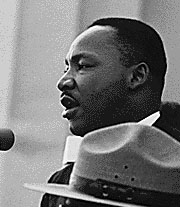
In fact, non-violence is sometimes even helped by the threat of violence to achieve its objectives. The non-violence of Dr. Martin Luther King, Jr., was complemented by the willingness to use "any means necessary" of Malcolm X. These two men were sending white America the same message concerning justice and racial equality. If whites failed to respond to the message stated gently, whites would be given the opportunity to respond to it stated violently. It took both statements to achieve the progress made thus far.
Now, in situations in which the bully can be overcome by violence and non-violence is hopeless, non-violence can amount to a kind of self-righteous passivity. That is, I may preserve my own sense of moral purity by adhering to non-violence, but it is sometimes far from clear that I am actually doing good. In such cases fighting is not an aggressive effort to destroy the bully, but an assertive attempt to stop the bully from bullying. World War II was ultimately that kind of moral struggle — neither Germany nor Japan was destroyed — they were merely forced to surrender. Now they are among the most economically powerful nations in the world. (One difference between aggressive and assertive use of military power is how you treat your opponents when you win.)
So, I think it is consistent for me to save the bee and to stand up to the bully. After all, if the bee's life is worth something, so is mine, and so is that of the bully. On the international level nuclear weapons are the horrifying alternative to such assertive valuing of life. Their potential for raising the violence of World Wars to universally unacceptable levels has prevented nations, including my own, from starting one for nearly fifty years. Pax Nucleus. Dangerous, but better than another World War. And an expression of our human nature.[7]
The Family of Nations
Some people argue that the goal of civilization is to raise our children so that wars don't happen. Unfortunately, we've had civilization for six thousand years, and our history has been as dysfunctional as our families. The only thing that's ever made us pause in our societal "addiction" to war is nuclear weaponry, and the realization that the next big war may kill us all.
But if war is humanity's heroin, nuclear weaponry is its methadone. That is, the treatment has potentially dangerous side effects. I am partly referring to the doctrine of deterrence by Mutual Assured Destruction, MAD. It is MAD, because it is intrinsically unstable, as those who lived through the Cuban Missile Crisis may recall. The Strategic Defense Initiative, (or Star Wars) was an attempt to move toward something more stable, and its successor, the Ballistic Missile Defense Organization (BMDO), may in time succeed, provided it is managed as a research program rather than as a political football. But even a successful BMD will not make the world stable against massively destructive war — it will merely make it more stable than it is now. BMD is a technical fix that does not address the real cause of the instability.
As long as war is the ultimate arbiter of international disputes, nations will arm themselves with ultimate weapons. And that means, that if something worse than nuclear weapons can be discovered and developed, it will be. And then we will find something worse than that, and so on perhaps until we, ourselves, prematurely punctuate the end of our universe with as big a bang as the one which began it. Nuclear weapons may actually be giving us a chance to learn to get along with each other before we get something really dangerous, a kind of world-historical warning shot.[8] The problem is not nuclear weapons, the problem is war.
Yes I know — I sound like the NRA, "Guns don't kill people. People kill people." I'm making a different argument. If you take a gun from a homicidal individual, he or she will usually not invent and build something worse. Nations will, whether or not you take away their nuclear weapons.
Now if the problem is war, the solution is peace, which nuclear deterrence by itself cannot achieve. Nuclear deterrence brings about only the absence of certain kinds of war.[9] Perhaps we can look for an opportunity to go beyond deterrence. Perhaps we can look at the international situation and the conditions necessary for peace.
During the Cold War, the military posture of the US and the Soviet Union was compared to that of two boys sitting in a pool of gasoline and threatening each other with matches. I suggest a more descriptive simile would be to imagine our countries as partners in a poorly arranged marriage on a one-hut island. God knows we would never have chosen each other, but divorce was not an option, because there was no place else to go. Neither was shooting our spouse. The only gun we had was a shotgun (our nuclear arsenal), and its pellets (environmental damage) would have ricocheted and hit us and the kids. The spouse had a shotgun, too, and quick enough reflexes to shoot back. In the middle of this impasse, the children got tired of being used by the parents to get at each other, and became hard to control. Some began to play the parents against one another, or against the other kids. Some of the kids made their own shotguns in an effort to be grown up and push the other kids around. Meanwhile the price of weaponry kept going up, and our other needs — taking care of the hut and island — became more pressing as the place kept getting more crowded.
Now one spouse has died, leaving her shotgun to her descendants, and family relations are a mess. At least since we've had shotguns around, no free-for-all knife fights (conventional World Wars) have broken out. The question now is to what extent we and the former Soviet forces can put down our nuclear "shotguns" without encouraging the "naughty child" nations who have made or are planning to make "shotguns" of their own to see what they can do with them.
The simile makes it clear that we need to work on international relationships. The relations between countries are often abusive affairs, in which power elites cynically use their own and other countries for short term gain. Lasting trust under such circumstances is unlikely. War is not. Just as peace cannot exist in a family in which members abuse one another, world peace cannot coexist with tyranny — of governments over people, or of governments over one another. Ultimately, we will choose one of Patrick Henry's alternatives. It will be liberty, or it will be death, whether we like it or not.
It will also be power, or rather empowerment of the powerless. Of course, established power groups fear empowering someone else. As the saying goes, "One with a full house rarely asks for a new deal." Consider how we Americans are doing with economic empowerment of our embattled inner-city black communities. [10] When people die younger and are incarcerated more frequently than their neighbors, they are not at peace, nor can they let their neighbors be. Federal programs can help, but making peace will take personal involvement, neighbor to neighbor. And deterrence of those who would attack their neighbors. [11]
Internationally, peace requires empowerment of some groups that seem eager to earn the hatred of the civilized world — like the Palestinians. Now that nuclear deterrence and economic necessity have combined to bring about more freedom, empowerment, and therefore peace in Europe, the Middle East is one of the next hot-spots for triggering a nuclear war. In order to have peace, the world must empower the Palestinians to determine their political and economic destiny, while at the same time it must deter them from warring with Israel. Such empowerment and deterrence will require the active involvement of the Islamic nations who thus far have been unwilling to empower the Palestinians to engage in much beyond stone-throwing and terrorism. May the Palestinians awaken to how they have been used by their brethren.
So we need to make peace, at home and abroad. Before you demonstrate to make your town a nuclear-free zone or to stop nuclear testing, [12] consider what you can do to enlarge someone's freedom, or to help them obtain the power to determine a better life for themselves. In other words, rather than fight against nuclear weapons or even against war, try making peace.
Meanwhile, I do what I can to make waging unlimited war dangerous, and preparation for it expensive. I can provide palliative treatment, but you, physicians/patients, must heal yourselves. Or to put it more bluntly, as long as we continue to express our human nature in disenfranchising, disempowering ways, we will cling to armament — nuclear or worse — to distance ourselves from our own nearness to war.
That White-Hot Morning
Of course, theorizing about the role of nuclear weapons in deterring all-out war long enough for economic pressure, public sentiment, and common sense to bring about enfranchisement, empowerment, and peace doesn't answer the question for some of my friends and family.
"Don't you feel like a whore?" one of them asked. If I worked only for the money, then I would. I consider my time, which I give up forever, to be more precious than the bodily contact a prostitute merely loans for his or her income. And I think it is a kind of pimp who compels his or her employees to work only for the money. At least, that is how I felt about the private-sector job I held before I came to my present position. [13]
But my friend was referring to the moral stain she perceives me to take upon my soul by associating with an industry of potential mass death and destruction. She believes that I am selling out by doing physics associated with instruments of doom. Permit me to rephrase her question to read, "How will you feel, on that white-hot morning, when the bombs fall, when we all die because of your handiwork? Don't you realize that if you and everyone like you just quit supporting this industry, it couldn't happen?"
I could say that if I didn't do it, someone else would, but that answer was rejected at Nuremberg. (It's also a better reason to leave the weapons program than to stay.) I continue to support the nuclear weapons business with my effort for many reasons, which I discuss throughout this piece. But mostly, I do it because the fear of nuclear holocaust is the only authority my own country or any other has respected so far when it comes to nationalistic urges to make unlimited war. As William L. Shirer states in his preface to The Rise and Fall of the Third Reich (Touchstone Books, New York, 1990),
"Adolf Hitler is probably the last of the great adventurer-conquerors in the tradition of Alexander, Caesar, and Napoleon, and the Third Reich the last of the empires which set out on the path taken earlier by France, Rome and Macedonia. The curtain was rung down on that phase of history, at least, by the sudden invention of the hydrogen bomb, of the ballistic missile, and of rockets which can be aimed to hit the moon."
Now this contrasts with the argument of those who would "reinvent government" by putting up bureaucratic roadblocks to maintaining the reliability of the US nuclear arsenal through research and testing. They reason that if the reliability of everyone's nuclear arsenals declines, everyone will be less likely to try using them. The problem is that some "adventurer-conqueror" may arise and use everyone's doubt about their arsenals to risk massive conventional war instead. An expansionist dictatorship might even risk nuclear war with weapons that are simpler, cruder, less powerful, much riskier (in terms of the possibility of accidental detonation) but much more reliable than our own may eventually become without adequate "stockpile stewardship."[14]
But the inhibitory effect of reliable nuclear weapons goes deeper than Shirer's deterrence of adventurer-conquerors. It changes the way we think individually and culturally, preparing us for a future we cannot now imagine. Jungian psychiatrist Anthony J. Stevens states, [15]
"History would indicate that people cannot rise above their narrow sectarian concerns without some overwhelming paroxysm. It took the War of Independence and the Civil War to forge the United States, World War I to create the League of Nations, World War II to create the United Nations Organization and the European Economic Community. Only catastrophe, it seems, forces people to take the wider view.
Or what about fear? Can the horror which we all experience when we contemplate the possibility of nuclear extinction mobilize in us sufficient libidinal energy to resist the archetypes of war? Certainly, the moment we become blasé about the possibility of holocaust we are lost. As long as horror of nuclear exchange remains uppermost we can recognize that nothing is worth it. War becomes the impossible option. Perhaps horror, the experience of horror, the consciousness of horror, is our only hope. Perhaps horror alone will enable us to overcome the otherwise invincible attraction of war."
Thus I also continue engaging in nuclear weapons work to help fire that world-historical warning shot I mentioned above, namely, that as our beneficial technologies become more powerful, so will our weapons technologies, unless genuine peace precludes it. We must build a future more peaceful than our past, if we are to have a future at all, with or without nuclear weapons — a fact we had better learn before worse things than nuclear weapons are invented. If you're a philosopher, this means that I regard the nature of humankind as mutable rather than fixed, but that I think most people welcome change in their personalities and cultures with all the enthusiasm that they welcome death — thus, the fear of nuclear annihilation of ourselves and all our values may be what we require in order to become peaceful enough to survive our future technological breakthroughs.[16]
In other words, when the peace movement tells the world that we need to treat each other more kindly, I and my colleagues stand behind it (like Malcolm X stood behind Martin Luther King, Jr.) saying, "Or else." We provide the peace movement with a needed sense of urgency that it might otherwise lack.
Now I admit that scaring people into becoming more peaceful smacks of terrorism. After all, using fear to coerce behavior is what terrorism is about. But if scaring people enough to stop them from making world war is terrorism, it's of a paradoxical sort, considering the terror of world war itself. It's similar to the 1994 "terrorism" of UN troops stopping the war in Somalia long enough to feed people. That is, the difference between deterrence and terrorism is the difference between forcefully confronting a bully and being one. Further, I suggest that those who deny the existence of such a distinction may be part of the problem of war rather than part of its solution.
Some people may think I have failed to put enough distance between my livelihood and terrorism — that hated word. To them I say that sometimes people become hated by some of their brothers and sisters in order to stimulate them to achieve a greater level of self-insight. Since I began this discussion with a friend comparing me to a whore, I mention for example the Hebrew prophet Hosea, who married a whore to make a point about the behavior of his community. I will return to this theme later.
For now I condemn real terrorism in the strongest terms — nuclear weapons work is what activities like terrorism lead to, more than it is terrorism itself. I also note that terrorism never achieves positive change. Such change is brought by peace-making initiatives that address the situation in which the terrorism arose, and that ultimately erode its popular support. Similarly, the threat of nuclear annihilation will change the course of history only if we, the people, respond to it by making peace. Otherwise we will continue on a path of self-destruction, whether we do it with nuclear weapons, or with some technology yet to be discovered.
"But face it," another friend said, "if you're not engaged in terrorism, you're at least making war. The whole war/violence/anger/hate business is like a giant tiger, and you're feeding it."[17] Put another way, she sees the institution I work for as allied with the forces of death, and therefore demonic. Now all human institutions are demonic to the extent that their members seek to preserve the institutions at the spiritual or physical expense of people or nature. Our cultural institutions (including our churches and governments) are what St. Paul called "the principalities and the powers" that rule this world (Titus 3:1) which we are to heal rather than abandon or destroy. [18] At work I offer my opinions to my colleagues and superiors in hope of constructively influencing their decision making, and I recommend that you do the same for your demonic institutions.
Of course, the constructive influence argument could have been used by Rabbis governing ghettos for the Nazis[19] — they helped to reduce the short term death rate, but they also made it easier for the Nazis to maintain control. But this situation is different — we now confront potential enemies with enough force to convince them that they have no hope of seizing control of the world in the first place. So I help maintain that deterrence, a paradoxical, insufficient, but necessary part of making peace. I do other parts in my spare time.
Still, there is the notion that because I did research related to nuclear weapons, I deserve a greater portion of guilt for what happens if they are used. Let me point out that even the anti-nuclear activists contribute to the nuclear weapons business, because they make war on nuclear weapons instead of making peace. They are shooting the bearer of the bad news that we can't make global war safely anymore. It's as if they want war to be safer, so that humanity can continue as before, making wars that only kill some of us. I hand them back the guilt[20] some of them wish to hand me.
In particular, I sometimes consider those who engage in anti-war or anti-nuclear actions (including some scientists who eschew defense research for moral reasons) without ever doing any actual peace-making to be in the same category that Dante seems to have placed Pope Celestine V. Celestine apparently abdicated the papacy out of fear that the worldliness that one must take on as Pope would jeopardize his salvation. Of him and his kind Dante says, [21]
...These are the nearly soulless,
whose lives concluded neither blame nor praise.
They are mixed here with that despicable corps
of angels who were neither for God nor Satan,
but only for themselves. The High Creator
scourged them from Heaven for its perfect beauty,
and Hell will not receive them since the wicked
might feel some glory over them.
In other words, I think that those who engage in peace protests without engaging in the enfranchisement of the disenfranchised, the empowerment of the powerless, and the deterrence of the willfully destructive may be serving their own desire to be morally pure, more than the cause of peace. Instead of acknowledging the difference between forcefully confronting a bully and being one, they advocate passivity, which just encourages the bully.
I hand you a hunk of guilt, too. You can't turn it down by worrying about what I do for a living. You can only turn it down by making peace. Start close to home. Do anything peacemaking. Learn ways to defuse your own anger. Show a poor kid how you do a home or car repair. Hug a person with AIDS. Ask your neighbors how they're doing and stick around for their answers. Anything at all. (You see, the opposite of peace is violence, which can be bred by neglect.) Start small and grow your effort. Grow yourself into someone who can think and act constructively regarding the US and the CIS, the Middle East, Central and South America, India and Pakistan, Southeast Asia, China, Africa, etc.
And sure, I'll feel horrible if that white-hot morning comes. We all will.
Preserving the Present Danger
Now if we want to make peace, much of the anti-nuclear movement distracts us from it by making war on war and pretending that it is making peace. Still, anti-nuclear activists do us a good turn by reminding us that maintaining an up-to-date nuclear arsenal is dangerous and expensive. The sooner we can get rid of it, the better.[22]
And we are getting rid of a large part of it. In business terms, nuclear weapons are a mature product line in a declining market, at least in the US and the former Soviet Union. Our arsenal is no longer needed at its present size to deter the Russian threat, nor in its present form to deter the emerging threat from third world proliferants.
But most anti-nuclear activists can't wait for what are essentially market forces to reduce our stockpile of nuclear weapons. They want disarmament NOW, regardless of the possibility that the present world without nuclear weapons may be unstable against conventional world war.
They are also oblivious to the idea that even a nuclear test ban can carry some risk to future generations. If the comprehensive test moratorium of the early sixties had held, we would have more multi-megaton weapons and more total megatons of explosive capability in the US and CIS arsenals than we do today. In other words, the world grew technically safer from nuclear winter during the cold war because of continued nuclear testing of new nuclear designs. Moreover, consider the devices that are incorporated into nuclear weapons to prevent their unauthorized use: how can we trust that they actually can prevent such use without testing them? Now the proliferation of nuclear weapons may make it necessary for us to develop ways to detect[23] and flexible responses to deter nuclear terrorism (including ways to disable terrorist nuclear explosives). I would hesitate to preclude such development given the present state of the world.
The anti-nuclear movement proposes to do just that, however. Recently proponents of Measure A, the nuclear-free zone initiative on the Alameda County, CA, ballot tried to make it illegal to design nuclear weapons at Lawrence Livermore National Laboratory within five years. The irony of this self-righteous measure is that it would have frozen the world at its present level of danger, instead of leaving it free to move carefully to a lower one.
And there is more to it than that. The Alameda County measure would have created a 15-member Nuclear Free Zone Commission complete with the power to hold McCarthy-style hearings, to make Blacklists, to determine educational curricula, and to institute unspecified five-year economic plans. If peacemaking is empowerment and enfranchisement, this is its opposite — it is a bid by a single-issue political group for power and control over others, pursued with the self-righteous religious fervor of the Inquisition.
Anti-nuclear activism [24] is indeed practiced as religion each Good Friday, when dozens of protesters picket the Laboratory. In their implied accusation they forget that, according to Christianity, we humans all stand together on the same side of the Cross — the one the nails go in. [25] (It's part of our human condition, and our blindness to it causes us to need our nuclear deterrent to refrain from world war.) As the Buddhist monk and peace-activist Thich Nhat Hanh remarked, "In the Peace movement there is a lot of anger, frustration, and misunderstanding. The peace movement can write very good protest letters, but they are not yet able to write a love letter." [26]
Between Good and Evil
Two years ago my wife and I attended a conference at the Center for Theology and the Natural Sciences of the Graduate Theological Union in Berkeley, CA. [27] When I replied to a fellow participant there that I work in a nuclear weapons lab, she practically jumped back from me. "I suppose a Lutheran could do that," she muttered, only half concealing her loathing.
Perhaps she was projecting, like the bullies of my youth. Perhaps she so badly needs to see herself as a peacemaker that she kills war in other people. In any case, she has a problem with nuclear weapons and the people who make them. But the real problem is not nuclear weapons — the problem is war, as I have said. In particular, it is the war-maker in every human soul.
The Talmudists noted that every human has two impulses, the evil, selfish impulse, yezer ra, and the good, altruistic impulse, yezer tov. [28] The evil impulse is necessary because, in normal circumstances, it helps us to be self-interested enough to procure food and raise families. It is only when it is overly indulged in that it becomes dangerous. Rather than to be excised, the evil impulse is to be brought into balance with yezer tov, and used as a tool for good. (Just as non-violent resistance harnesses rather than eliminates violence.)
With the above statement as background I observe that many peace activists confront the evil impulse in the powers of war with the evil impulse in themselves. They rightly see nuclear war as a threat to the planet, and therefore a threat to themselves and humanity, and so confront the threat of violence with anger. Such an attitude is self-defeating, because acting from it creates more conflict, rather than less. Rather than making peace, such action merely makes war on war.
Now the peace activists didn't invent this type of response. In the same spirit, nuclear weapons were first invented by good people who were confronting the evil of the Nazis (who were trying to develop their own atomic bomb) with the evil impulse in themselves. And by continuing to develop and/or maintain a stockpile of them we give our assent to this evil impulse. I give my assent.
I give it because in response to the Nazis, I would have done the same thing. In response to Stalinism, I would also have done as my predecessors did. I believe that Nazism had to be defeated at all costs, and Stalinism had to be contained, in order to preserve and enlarge the freedoms that I hold dear for myself and for all people. Such a response satisfies the criterion of Utilitarianism — the greatest good for the greatest number — at least in its outcome so far. Even the atomic bombing of Hiroshima and Nagasaki, which hastened the defeat of the evil of Japanese Imperialism, satisfies the criterion of Utilitarianism in that it spared the loss of American lives and the even worse devastation of Japan and loss of Japanese lives that would have resulted from a conventional invasion. And I suppose I would have supported it for that reason. (And if you think there we could have demonstrated the bomb over an unpopulated area, remember that we used our entire stockpile of two bombs, and that it took two cities, to bring about the surrender.) [29] But the image of an orphaned baby, burned and screaming, annihilates forever the argument that it was good. [30] It was an evil response of good people to evil, and it was the best that we humans could do at the time.
And so the question of whether I am good or evil in my participation in the nuclear weapons business is already contained in the discussion of yezer tov and yezer ra, above. Or in the Christian idea that we are simultaneously sinners and saints. I am neither one nor the other — like you, I am both. In associating with a nuclear weapons program, I confront the evil of potential aggressors against America with my own evil impulse. On the other hand, it is necessary (but not sufficient) for us to defend our turf, even in this outrageous manner, if we are to defend our freedom. (Otherwise we risk being attacked just for being vulnerable. And if the old enemy is no longer visible on our horizon, all we need do is to become complacent for a new one to appear.) Just as an individual needs his evil impulse to live, so does a nation. The question is not how to eliminate the evil impulse — the question is how to harness it. How can we use it for good?[31]
I remember my third grade teacher, who disciplined a boy during recess for beating up other kids. Rather than strike him or yell at him, she made him stay still for the rest of the recess by holding his hand. He was close to tears after ten minutes of this firm, but gentle torment, and he gave up picking fights at school thereafter. With love rather than anger, she had used overwhelming physical force to stop a bully.
How to apply her kind of force in the nuclear age is a challenge which, as of this writing for example, the world still faces with regard to Saddam Hussein's Iraq. The price of the world's failure to apply such force when needed, and of bully nations' failure to respond to it, will be high — I guarantee it. And I believe that we must look to something greater than ourselves if we are to succeed.
The Bomb and the Cross
Mohandas K. Gandhi and Martin Luther King, Jr., the two greatest champions of non-violent resistance in recent memory, acted when their adversaries could be restrained by the majority of the their own people. And I have argued that war, especially nuclear war, is outside the type of human situation in which non-violent resistance works. From their statements and their lives, as well as their deaths, it is clear that these two men would regard that argument as beside the point. Gandhi declared that he would use non-violent resistance as a matter of principle even against a nuclear attack, [32] and Dr. King was preparing to lead a non-violent struggle against the Vietnam War. Rather than concern themselves with whether non-violence would "work," these men took up the path of non-violence as a way of being, of participating in reality (the "moral Universe," as Dr. King put it). The lives of these two men remind me that, up to this point, I have avoided dealing with this way of selfless self-actualization. The Christian name for it is the way of the Cross.
"When evil attacks," an associate in the nuclear design program told me, "you die to your self-interest, and just take it. That way evil expends itself, it blows until it runs out of breath. And by letting it overcome you, you overcome it, because Christ takes it for you. Evil blows itself out, and you, spiritually if not bodily, are left standing." Such is the way of the Cross as experienced from the Cross.
This type of self-sacrifice has a potential redeeming effect on the evil-doer, because it offers him (or her) the opportunity to re-evaluate himself and his pursuits in its light, should he choose to do so. The non-violent resister, by acknowledging full responsibility for his or her own actions in a confrontation, invites the evil-doer to acknowledge responsibility for his, as well. The non-violent resister holds up a mirror to the evil-doer showing him both as he is and as he can become.
A complimentary type of mirror was employed by Oscar Wilde in his novel, The Picture of Dorian Gray. Gray came into possession of a portrait of himself as a young man. Gray led a life of debauchery and deceit, but none of this left its mark on his ageless face. The picture, however, did age, becoming perceptibly more hideous with Gray's every foul deed. Eventually Gray could no longer stand to look at the picture, or even to know that it existed, and thrust a knife into it. The next morning Gray was found dead, an ugly old man with a knife in his heart, lying next to the portrait of his handsome younger self.
Although Gray wished not to know it, the picture showed him as he truly was. Rather than to attack the portrait, Gray would have done better to own up to the testimony the picture bore of him, and change his ways. Only in this manner could he have improved its appearance. So it is with nuclear weapons and society. Like Dorian Gray's picture, they show all of us in the world who we are. Similarly, trying to destroy the portrait, or the ones who paint it, will avail us little. The only choice which leads to life is for us to own up to what they say about us, and begin treating each other better.
Being made to know who we are, when we would rather not know, is what I call Judgment. It is inseparable from participation in "the moral Universe," which I call Grace, because this participation implies participation in Truth, including the Truth about ourselves. When we own up to who we are, which I call Confession, we experience reality as Grace rather than Judgment. Now the way of the Cross, the way of Grace, shows us so gently who we are that we can easily look away. And so, in addition to the gentle mirror, we have the mirror which is all Judgment, the Picture of Dorian Gray — nuclear weapons and the obscene horror of nuclear war. [33]
The Soul of the Bomb
In the polytheistic psychology of James Hillman, the ultimate reality is soul as theater. Everyone and everything has soul, and therefore contains many actors or "gods," personified images whose consciousness must be entered and explored via the imagination. Thus Hillman claims that the atomic bomb belongs to Christian apocalyptic's embrace of spirit over soul, rather than to ancient Greece's noble Ares, and that its god within is the "god-is-dead" god of absolute nihilism. [34]
Look more closely, James. Come to the Nuclear Weapons Refresher class at Sandia National Laboratories, Albuquerque. Look inside a "cutaway," a sawn-open, full-sized model of a nuclear warhead. All parts that pose no chemical or radiation hazard are real. Is this Shiva's third eye, the sword of Ragnarok, or is it the last trumpet heralding Judgment Day (an image as Islamic as it is Christian), the Wrath of God entering the world through the gate of our own folly?
Explore with your imagination, James. Enter into the consciousness of the scientists, engineers, and bureaucrats who make up the class. Attempt to hide from yourself the horror of the bomb's potential use by becoming fascinated with the details of its construction. [35] Use each component and subassembly to avoid seeing in its totality the shape of human anger. And amid all the explosive sculpture find the pieces that prevent accidental or unauthorized nuclear detonation. The box that holds the beast has resident a refugee from Pandora's box — Hope sits atop each mechanism of restraint, asking if we're really sure we want to do this, offering a little prayer that if the end must come, let it come some other way at some later time. [36]
So, remember this. If each part that makes the thing go embodies negation of our world, then each part that makes the thing stop embodies affirmation. The soul of the bomb contains both. It is a complex thing, like the will that called it into existence, which is linked inextricably with the wish that it would go away without a prior metanoia, a profound change in human nature. Both the will and the wish originate in the urge to make war on war.
The Absurd Man
The existential aspect of my work in "Defense Sciences" – what it meant to me, or perhaps what meaning I gave to it — has been my focus up to this point. I kept my country from appearing vulnerable to would-be bully nations. I painted humanity's nuclear Picture of Dorian Gray. I gave you your nuclear methadone because you need it, while I remind you that you still participate in humanity's war-addiction. It's confrontational of me to do so, and by itself, at odds with the way of the Cross, as was Jesus' violent outburst in the Temple. On the other hand, as a Christian lay pastoral care-giver, I used a confrontational style with a real addict in recovery who had begun resuming his old habits. He stopped using his drugs. Similarly, although the nuclear powers have resorted to war, the fear of nuclear escalation has restrained them in their use of it, and they have even lost. So much for why I stayed.
I came because I wanted a job where I had some power over my employer — which for a scientist means the power of unalterable physical reality, the power of truth as observable, testable fact. I knew from my graduate school experience of working part-time as a defense researcher that defense labs were closer to this ideal than what I had found in industry, so that was where I applied. My present employer made me a good offer, and I took it.
And what I found in the shadow of the bomb was peace. It's almost spooky how much nicer the people in nuclear weapons design are than most of the folks I knew in academia or private industry. Maybe it's because the considerations I've outlined above give us pause. Maybe it's because we feel confident that truth still generally wins over power in decision making at the lab. Maybe it's because the disapproval we experience or expect to experience from so many good people encourages us to form a more close-knit group.
It's nice to work in a community where science is still generally understood and respected by managers, and where management has the ability to stick with long term projects. Such a community could be a valuable national or global resource. The National Laboratories can evolve into the National Institutes of Energy, or the National Institutes of the Environment, or even the National Institutes of Industry, and play a role in those areas like the National Institutes of Health plays in medicine, provided that our leadership develops clear long-term national policy to guide them. (Otherwise we risk turning the national labs into "job shops" consisting of many small isolated groups of scientists competing for small contracts — the people and facilities may remain, but the corporate culture that enables the labs to pursue large, long-term projects of national or global importance will not.) Oh well. In America, we get what we vote for.
And we get what we tolerate. We as a nation would be stronger, richer, and more peaceful if our ideal of management and government included more empowerment and less bullying, but that is a subject for another essay. [37]
Meanwhile, I think about by my situation. Working at a nuclear weapons lab seems monstrous when I listen to my friends' kids. Then I listen to the news, and go contentedly back to work making a living from a job that wouldn't exist without Human Sin. When I mentioned this to my pastor, he shrugged and replied sadly, "Neither would mine."
Looking Backward
My foregoing rationalizations regarding nuclear weapons for America are very nice, but what about my counterparts in England, France, Russia, China, and (assuming the rumors in the press are true) India, Pakistan, Israel, Iraq, Iran, North Korea, and so on, who could make essentially the same arguments that I have? We Americans feel pretty comfortable about England, France, and even Israel having nuclear weapons, because we know them. We're friends. They're mostly white, like we are so far.
But more to the point than the racist overtones noted above, these countries are committed to representative democratic capitalism, our way of life. We westerners take it as self-evident that this is the best way of life for all humanity, and historically, we have made ourselves enemies of all cultures that did not embrace it.
That our way of life is just one way to live rather than the only way — that western-style representative democratic capitalism (and its attachment to modernity) is particular rather than universal — is the theme of Hichem Djait's Europe and Islam (University of California Press, 1985) for example. Given that truth, how do I affirm my commitment to keeping my culture well-armed without giving my counterparts in other cultures the opportunity to use my arguments for their own purposes?
I could point out that more people were killed in peacetime by totalitarian regimes in the twentieth century than in all its wars. (Or that more people were killed in in the 20th century by machetes than by nuclear weapons.) But western-style representative democratic capitalism may not be the only alternative to totalitarianism. Our culture has serious problems, which I hope it will outgrow.
A more fundamental argument is this: Any country that, in addition to deterrence, practices enfranchisement and empowerment, is in the business of making peace. Those who practice deterrence alone are in the business of making war, and are themselves to be deterred from it by any means necessary. As I said earlier, peace cannot coexist with tyranny — the choice is ultimately liberty or death, whether we like it or not. My counterparts in war-making countries take note.
Now this, like many of my arguments, presupposes that America is and will continue to be a basically benevolent nation, dedicated to the enlargement of human freedom at home and abroad. This is essentially a statement of faith, given the depressingly large body of evidence any competent historian could muster to the contrary. [38] Rather than argue the point, I simply mention that the United States is now in the best position that any country ever has been to make a military conquest of the world. Either we are not going to do it because we are a relatively good people, or we are not going to do it because of our fear of nuclear war. I therefore rest my case for nuclear deterrence, even if the case that it is more moral for the United States to engage in such deterrence than many other countries remains open.
And perhaps it is well that I let it remain open, because most Americans tend to be too self-righteous about that point. I leave it as a challenge for myself and my fellow Americans to act in such ways as to make my assertion of America's basic benevolence true. We might begin by reminding ourselves of our commitment to human rights as defined in our Constitution, which I consider myself bound to uphold and defend against all enemies, foreign and domestic.
That we Americans would never abandon the principles of our Constitution [39] is perhaps the boldest assumption I have made here. We have strayed from them in past years when it suited us. That we will never stray too far is something upon which I would seem to have bet my soul if, as a person of faith, I had not entrusted it elsewhere.
Notes
- [1] I am indebted to Hugh Gusterson for delineating and naming these positions in a lecture delivered at Lawrence Livermore National Laboratory.
- [2] For a discussion of evil as a psychological character disorder see M. Scott Peck, People of the Lie, Simon and Schuster, New York, 1983. See also "Reviving a Dead Language," at this web site.
- [3] For more on assertive behavior see Robert E. Alberti and Michael L. Emmons, Your Perfect Right, Impact Publishers, San Luis Obispo, CA, 1987.
- [4] Gandhi's non-violence did not preclude his organizing an Indian Ambulance Corps to assist the British in the Boer War — non-violence and pacifism are not necessarily identical.
- [5] Max I. Dimont, Jews, God, and History, Signet Books, 1962. Dimont also notes mass demonstrations against the deportations of Jews in Bulgaria. See also, Abba Eban, My People, Random House, New York, 1968.
- [6] Perhaps Gandhi himself sensed something like this. Whatever the motives of this complex man, he refrained from demanding that Indians refuse to fight in WW II. That said, non-violent confrontation may have worked against the Nazis if it had been used by the bulk of the German people before the Nazis had consolidated their power and diminished the possibility of such collective action. Even then there were at least three successful, but limited, instances of non-violent resistance in Germany itself — protests by Catholics against the substitution of swastikas for crucifixes in local schools, protests by "Aryan" wives against the deportation of their Jewish husbands, and protests against the euthanasia of the "unfit." (See Nathan Stolzfus, "Dissent in Nazi Germany," The Atlantic, September 1992.) As I said earlier, the "right" people must use non-violence against the "right" opponent at the "right" time. In the case of the Nazis, the "right" people sold out to them, leaving war as the best alternative for the rest of the world. In fact, the need to preserve unity in support of the war effort was cited by Nazi officials as the principal reason for giving in to these protests.
- [7] A further exploration of the need for forceful confrontation in another context is given by Kenneth Haugck in Antagonists in the Church, Augsburg Publishing, Minneapolis, 1988. The subtitle is "How to identify and deal with destructive conflict." While Haugck does not advocate physical violence, he is dealing with churches rather than international relations. In international relations the use of Haugk's moral confrontation is sometimes meaningless unless backed up by a willingness to use force.
- [8] Not only can the genie of nuclear weapons not be put back in the bottle — the next genie may already be on its way out at some university somewhere in the world. Perhaps it's premature of me, but I'm somewhat worried that I've never met anyone — scientists included — who even considered the possibility, let alone tried to plan a response to it. In other words, a solution to the nuclear weapons problem that leaves us no better equipped to deal with an emerging weapons technology than we were before may accomplish nothing.
- [9] This argument is sometimes used to justify the idea that nuclear deterrence accomplished nothing, because the superpowers engaged in proxy wars which led to death and destruction in the "third world." Those who advance that argument may be forgetting to extrapolate the dramatic escalation in destructiveness from WW I to WW II. A non-nuclear but otherwise high technology (including chemical and biological weapon technology) WW III might be a good deal nastier than most of us imagine.
- [10] I use the word community here, because it has become a standard designation. If people were really in community with one another in these places, there would be far less "black-on-black" violence.
- [11] The idea of personal involvement to make peace by "building community" is discussed at length in M. Scott Peck, The Different Drum, Simon and Schuster, New York, 1987. Here, I specifically call attention to the roles of enfranchisement, empowerment, and deterrence in that process.
- [12] We are now at a moment of historical opportunity (due to the collapse of the Soviet Union) to try another moratorium on nuclear testing. However, I think we need to do certain nuclear tests to enable the nuclear weapons program to be maintained before we begin such a moratorium. See "Testing, One, Two, Three, Four," an unpublished essay of mine.
- [13] "The ruler of his soul surrenders in mind all work...he neither does selfish work nor causes others to do it." —The Bhagavad Gita 5:13, translated by Juan Mascaro, Penguin Books, New York, 1985.
- [14] See "Testing, One, Two, Three, Four..." probably never to be published.
- [15] Anthony J. Stevens, The Roots of War: A Jungian Perspective, Paragon House, New York, 1989, pages 216-217.
- [16] And I'll bet that if something worse than nuclear weapons is invented, it will come as an unintended by-product of research undertaken for humanity's good. Who would have guessed, for example, that research on textile dyes would lead ultimately to chemical weapons, or that biological weapons would result from efforts to cure infectious disease? That is to say, shutting down nuclear weapons labs will not protect the world from the danger of radically new weapons. Only peace-making in the form of enfranchisement, empowerment, and deterrence can do that. And part of deterrence is the preparedness that weapons labs provide to respond to the invention of radically new weapons by someone else.
Of course, we could just try for a world-wide halt to scientific research and technological change. This is obviously not desirable because technological change serves humanity like biological diversity serves life in general — it gives us ways to cope with new challenges to our existence. For example, medical scientists deliberately forced the smallpox virus into virtual extinction. Nor is halting technological change possible, because the demand for such change is so great — people want the new stuff so much that they actually buy it.
- [17] Or is the "tiger" feeding me? After all, I do get paid for my work.
- [18] I am indebted to Pastor Len Nelson for pointing this out.
- [19] There are some who think I should compare myself to the engineers who designed the Nazi gas chambers instead. It is true that the path into group evil is taken in small steps, each with its own rationalization, and I and my colleagues know it. But systematically eliminating a vulnerable population to achieve societal purity is different from raising the specter of deadly force against armed opponents who will respond to nothing else. Thus, for example, I do not regard the bombing of Hiroshima and Nagasaki as a war crime in the same sense as the Nazi's genocide of the Jews. On the other hand, the difference will become moot if we and our adversaries engage only in deterrence without empowerment and enfranchisement. Moreover, many of the folks who compare people like me to Nazis dismiss or dehumanize us with language borrowed from psychiatry. They might do well to remember how the Nazis used psychiatric and biological terms to dehumanize their chosen "undesirables."
- [20] In fact, the emphasis on guilt can itself be sinful (or estranged) when it allows us to avoid confronting ourselves. Shelby Steele has a penetrating discussion of it as related to racism in The Content of Our Character (St. Martin's Press, New York, 1990) under the phrase "seeing for innocence." Here, of course, the particular form of sin is "nuclearism", both pro- and anti-.
- [21] The Inferno, Canto III, translated and annotated by John Ciardi, Mentor Books, New York, 1954. Stephen Sondheim stated a similar sentiment with one line in Into the Woods: "You're not good, you're not bad, you're just nice."
- [22] Of course, the "zero option," in which nobody has any nuclear weapons makes the value of having just one become infinite, which makes cheating irresistible. The total elimination of nuclear weapons by the current nuclear powers would simply create a world in which nearly every country secretly has just a few. Such a world might be less stable against nuclear weapons actually being used than our present one.
- [23] In particular we may need to do research and testing to anticipate how proliferants may work around restrictions in materials and technology, so we can avoid being unpleasantly surprised some day.
- [24] I use the term anti-nuclear activism rather than peace activism for two reasons. First eliminating nuclear weapons will not in itself make peace — it will merely change the calculus of war, until something worse is invented. Second, the kind of anti-nuclear activism I have in mind tends to generalize itself into protest against nuclear energy and irradiated food, as in the case of Alameda county measure A. It is a quest for purity that refuses to examine the possible negative consequences of its success. For example, if the global warming hypothesis is correct, nuclear reactors may become the most environmentally responsible means of producing the energy needed to sustain our populations, let alone our cultures.
- [25] See "Killing Christ," at this website. I would prefer that the protesters arrive on Easter Monday. While Christianity does challenge all Christians regarding how we live in light of the Crucifixion, its central challenge is how we live in light of the Resurrection. After such glorious Good News, it's shocking that we all go back to business as usual. After thus challenging us weapons scientists to wonder about our jobs, the protesters could return home to wonder about their own. Such a protest would be more intended to heal rather than hurt — besides being more sincere than the Good Friday protest, it would be more peaceful.
- [26] Thich Nhat Hanh, Being Peace, Parallax Press, Berkeley CA, 1987.
- [27] The subsection title is from the Buddhist koan, "Between Good and Evil, how great is the distance?"
- [28] Baruch M. Bokser and Ben Zion Bokser, The Talmud: Selected Writings, Paulist Press, Mahwah, NJ, 1989. It is no accident that the Talmudists considered the instinct for self-preservation to be part of the evil impulse. While the drive to preserve onself is good under most circumstances, it is fairly easy to manipulate that drive to get people to participate in evil. See "The Leviathan, Inc.," at this web site.
- [29] Or take a look at Japan's Longest Day, compiled by the Pacific War Research Society, Ballantine Books, New York, 1983. The Japanese authors show that even after the two atomic bombings, the Japanese leadership was still seriously divided with regard to surrendering. The Emperor's courier had to run a gauntlet of assassins to sneak the recorded surrender speech to a broadcast studio. Now some elements of Japan's leadership may have been exploring a negotiated surrender with the Soviets. Most likely this faction was simply trying to avoid a peace that involved the occupation of Japan. I think that any such peace, which would have allowed Japanese society to avoid transforming itself into the relatively peaceful country it is today, would have been unconscionable. Besides, the Soviets were only looking for an opportunity to divide Japan as they divided Europe. Given that Communism prevented social transformation (one has only to note the re-emergence of anti-Semitism in the former Soviet Union and Eastern Europe following Communism's collapse) I think that it would also have been unconscionable to have permitted the division of Japan. Had we entered into negotiations with Japan, their divided leadership would most certainly have stalled until such a division took place. In other words, those who insist that there were paths to peace other than by way of the atomic bombing of Japan must consider the kind of peace that would have ensued. They should also consider that Japan had its own nuclear weapons program, and that the initial Japanese reaction to the bombing of Hiroshima was to ask if their scientists could produce an equivalent bomb in six months — see Paul Johnson, Modern Times, Harper and Row, New York, 1983.
- [30] Ironically, what I had remembered as an image of Hiroshima turns out to be H. S. Wong's photo taken after the Japanese conventional bombing of Nanking on August 29, 1937.
- [31] In fact, non-violent resistance works by harnessing the "evil impulse" in the non-violent resister as well as in the society targeted by the resistance — Gandhi believed that people had to have some "fight" in them in order to be resisters at all. See Erik H. Erikson, Gandhi's Truth, W. W. Norton & Co., Inc., New York, 1969.
- [32] Erik H. Erikson, op . cit.
- [33] Readers of the Qur'an will note that in Sura 27, "The Ants," verses 18-19 Solomon hears the distress of the ants at the prospect of being trampled by his armies. I presume he spared them, indicating that we should preserve and respect the environment and its inhabitants even in wartime. Thus weapons of mass destruction may present ethical dilemmas for Muslims, too.
- [34] James Hillman, A Blue Fire, selected essays introduced and edited by Thomas Moore, Harper Collins, New York, 1991, pp 180-185.
- [35] This would be Lifton's "psychic numbing" if it actually worked.
- [36] Greg Simonson pointed out to me that a nuclear weapon likely to be designed by proliferant state (none of which are predominately Christian) for use in a regional conflict would probably not include any safety or use-control features.
- [37] "Leviathan, Inc.," at this web site.
- [38] On the other hand, what was it that Shakespeare has Mark Anthony say? "The evil that men do lives after them; The good is oft interred with their bones..." The historical record is seldom entire, nor is it merely a collection of facts. It is inseparable from our need for it to serve as the mythic basis for our self-understanding, whether to support arguments for or against a given question. Thus, the argument as to the basic goodness of the United States may be unresolvable in any final sense. Moreover, the evidence for the basic "badness" of the United States could be lumped together with the evidence for the basic "badness" of all humankind, which can serve as another point of departure for asserting the salutary effect of the bifurcation that nuclear weapons introduce into our sense of human history: either we become more peaceful, or we self-destruct.
- [39] See, "The Righteous State," at this web site regarding my principal anxiety on this point.