01 November 1995

Splendor is as Splendor Does

A Critique of the Encyclical Veritatis Splendor

[Truth's] first appearance to our eyes, bleared and dimmed with prejudice and custom, is more unsightly and unplausible than many errors...  — John Milton, Areopagitica, 1644

Veritatis splendor, the Splendor of Truth, is an open encyclical letter sent in August 1993 by the supreme pontiff, Pope John Paul II, to all the bishops of the Catholic Church, regarding certain fundamental issues of the Church's moral teaching. It is well written, closely reasoned, and often beautiful. But I have a few problems with it, and as they say, the devil is in the details.

Now I trust I can be forgiven for reading mail intended primarily for someone else — I'm neither Catholic nor a bishop — but as a Christian, I wanted to examine the line drawn by the man whose job is being the successor of Peter. Beyond that line, according to John Paul II, are acts that are intrinsece malum, intrinsically evil, at all times, under all circumstances, for all people. That is, in the Biblical commandments as interpreted faithfully by the Church, and especially in the prohibition of certain acts, we find an Absolute Morality based on Absolute Truth.

His Holiness begins by elaborating upon the idea in John's Gospel that Christ is the light that enlightens every one who comes into the world. He even treads close to the edge of Universalism by quoting the Second Vatican Council (Vatican II) to the effect that non-believers who have not heard the Gospel, yet who strive to lead an upright life, may receive God's Grace.

John Paul II then notes that certain teachings in the secular world, as well as in the Church and her seminaries, seek to dissolve the "intrinsic and unbreakable bond" between faith and morality. That is, they undermine the meaning of morality itself and its place in the relationship between people and God. Such teachings include situation ethics and other forms of moral relativism.

To set things straight, His Holiness takes as his text the dialogue of Jesus with the rich young man, reported in Matthew 19. This is the dialogue in which Jesus said that to obtain eternal life the man must first keep the commandments, and then sell all he has, give the proceeds to the poor, and become one of Jesus' followers. The man, rich in goods, but poor in spirit, rejected Jesus' offer, and "went away sorrowing." The apostles, realizing that they couldn't make such a sacrifice either, wondered aloud whether anyone could obtain eternal life. Jesus then answered them, "With God all things are possible."

Most of the papal exegesis of this passage is straightforward, and should be something upon which all Christians can agree. The Pope states that there can be no freedom, no authentic life apart from a commitment to truth, that Absolute Truth exists and makes itself known to humankind, and that the moral life is a loving response to the experience of that Truth.

However, His Holiness then stoops to lift up before his audience a strange, but customary, misreading of the Gospel. He claims that Christ rejects the right to divorce. Now Jesus did state that, despite its permission in Mosaic law, divorce is in most cases equivalent to adultery, but that is by no means a prohibition of divorce. He merely identified what you are doing when you get one. His statement is to be taken in context with Jesus's other pronouncements against the self-righteousness of those who believe themselves good because they think they keep the letter of the commandments while ignoring their spirit (such as, "Let one among you who is without sin cast the first stone," spoken about the woman taken in adultery, or "Whoever looks upon a woman with lust has already committed adultery with her in his heart"). That is, Jesus was using irony to communicate the idea that we condemn adulterers while at the same time thinking and doing what is nearly adulterous, thus convicting us of two sins — adultery and hypocrisy. The Mosaic law itself, as Jesus said, remains unchanged until the end of human history, which means that divorce is an allowed, if gravely disapproved, option.

Specifically, Jesus said that not one point of the Law would be changed "until all is fulfilled," which many Christians take to mean, "until after the Crucifixion." That's what Bonhoeffer termed "cheap grace," an absolution one confers upon oneself without reference (or deference) to God. Clearly all is not fulfilled because we are still here. Our lives are the fulfillment of God's intention for us, which intention is not fulfilled until we are finished living. Christians tend to willfully misinterpret that phrase because they wish to excuse themselves from keeping the 613 statements of Law in the Hebrew Bible. They are not excused. They may be forgiven, as when Peter forgave adult male Gentile converts to Christianity their obligation to become circumcised, but they are not excused.

Peter forgave them this obligation in order to enrich people's lives and liveliness by welcoming them just as they are into the family of God. If he had insisted on circumcision, he would have committed the evil of abusing the Law to diminish their lives by setting up impediments to their faith. When the choice was forced upon him, he chose to follow the Law's spirit rather than its letter. It would improve the practice of Christianity if all Christians, especially those in leadership roles, would do likewise. Otherwise, they are excusing themselves from following the laws they break, while condemning those who break the laws they follow. Such hypocrisy is equivalent to beating someone because their style of sin is different from your own. As Jesus said, "First take the log from your own eye, so that you can see clearly enough to take the speck of dust from your brother's eye."

This point about Law and Gospel brings us to the list that His Holiness quotes from Vatican II. This is the list of things which are intrinsically evil in their object (or aim), of things which in no way can be ordered to give due honor to God. Such acts include

Whatever is hostile to life itself, such as any kind of homicide, genocide, abortion, euthanasia, and voluntary suicide; whatever violates the integrity of the human person, such as mutilation, physical and mental torture and attempts to coerce the spirit; whatever is offensive to human dignity, such as subhuman living conditions, arbitrary imprisonment, deportation, slavery, prostitution and trafficking in women and children; degrading conditions of work which treat labourers as mere instruments of profit, and not as free and responsible persons....

And, of course, His Holiness adds contraception to the list.

Might I point out a contradiction here? Let us accept that contraception is indeed a denial of the honor due to God because it allows us to abuse the gift of sexuality by separating it from the joyful submission to God's will regarding our possible subsequent parenthood. Nevertheless, given that whole populations cannot be expected to be abstinent, the proscription of birth control condemns millions of people to subhuman living conditions brought on by overpopulation. In other words, consistency demands that we consider the banning of contraception itself to be intrinsically evil according to the Vatican II list.

This is not to say that his Holiness is wrong to continue the ban on contraception. I simply point out that since contraception and banning contraception are both evil, the ban on contraception should not be absolute. Since it is evil, absolute prohibition of contraception cannot be an example of Absolute Morality based on Absolute Truth.

Now to choose the lesser of two evils, such as between banning and permitting contraception (or abortion), one needs a sense of their proportion, which is exactly what the Vatican II list lacks. For example, abortion is vastly different from the Nazi genocide of the Jews. Let us agree that an abortion kills at least a potential human being, that it is normally undertaken soley for that purpose, and that it is indeed incapable of being ordered to honor the Creator. However, quickly killing less-than-fully-sentient fetuses is far less cruel than slowly and systematically starving, overworking, overcrowding, and tormenting captive people until they are reduced from loving, sensitive, intelligent human beings into filthy, diseased, miserable creatures struggling like animals to survive one more day, so that when you finally torture them to death, it seems to you no worse than exterminating rats or other vermin. The Nazi genocide was a war against the soul, of both the victims and the perpetrators. Those who fail to see that it was vastly more monstrous than abortion are themselves capable of letting such a crime happen again.

This brings us to the real objection I have to Veritatis splendor — the point about faithful interpretation of Absolute Morality by the Church. Absolute Morality is too large to be contained in a set of proscriptions, because its basis, Absolute Truth, is too large to be encoded in mere language. (Otherwise we would have had a long speech instead of the Incarnation, which was a whole life.) The interpretation of Absolute Morality must be in deeds as well as words. And during the Holocaust, the Church did poorly.

To be blunt, it shames Christianity that a single Christian cleric anywhere in Europe escaped the concentration camps. With isolated exceptions like Bonhoeffer, the bulk of them laid low, choosing not to annoy the Regime. That is, when the Church was called to follow her Lord to the Cross, the Church shrank from her calling (like Peter denying his Lord three times before the cock crowed twice) and chose to be quiet, to outlast the Nazis, to survive, as did the current Pope.

As would I, left to my own devices. I'm no braver than the next man, but just because I would do a thing myself, does not make that thing right. In other words, when I criticize the Church on this point, I am only accusing my brethren of sharing our common humanity. Nevertheless, I feel compelled to say that the Church and her Magesterium catastrophically failed to speak and do the Truth in this century, and thereby contributed materially to the torture and massacre of millions. That is, the Church had the power to stop the Nazis early on through self-sacrifice, had she tried, and she did not try.

I therefore accept the notion of Absolute Morality based on Absolute Truth, but reject the Church, despite her Magesterium (divinely ordained doctrinal and moral teaching authority) as its sole or even its best interpreter, because she has disqualified herself from that role. Rather than a lover of Absolute Truth, she historically has been too often its fair-weather friend, speaking sternly when secure, staying silent when threatened. In other words, if I can't trust the Church for the Truth when the chips are down, how can I trust in other times that the Church is not speaking from a myopic and insensitive authoritarianism? How can I be sure the Church is not just bullying people in order to assert some power over their behavior?

Rather than trust the Church for Absolute Morality, I, Protestant that I am, trust God alone. Based on that trust, I call on the Church and its leaders to confess and to repent their contributory culpability for the Holocaust. Then they can overcome the hubris brought on by denial of their collective survivor guilt. Only then can they interpret the Biblical commandments with the humility that is necessary to approach anything like fidelity.

And while we can and indeed must forgive the Church her sin, both we and the Church must always remember. Let the Church speak more carefully then, like St. Peter, and be gentle with the Law that she may not herself oppress the people.

30 October 1995

Killing Christ

One of Humanity's Favorite Pastimes
1991 - 1995
He who begins by loving Christianity better than truth will proceed by loving his own sect of the church better than Christianity, and end in loving himself better than all. — S. T. Coleridge: Aids to Reflection, 1825


Naked Church

The attribute of Zen Buddhism that I admire most is that it has no dogma (no predigested formulation) that its followers must accept. Zen adherents claim that Zen is Enlightenment, which is simply the constant, direct awareness of reality. This awareness is claimed to be so much clearer than the communal experience of reality we share in daily living that it is beyond language to describe. "He who speaks does not know, he who knows does not speak," is a standard Zen saying. Moreover, because Zen attempts to bridge the gap we Westerners feel between the self and God, Zen devotees venerate the Buddha, but they do not worship a personified god. Zen is very lean, without most of the trappings that we in the West usually associate with religion. Zen embraces concept of reincarnation and the practice of meditation (which is just discipline for awareness) but neither of these is essential to Enlightenment .

The central symbol of Zen is the Buddha. Tradition has it that he became so completely enlightened that he perceived and participated in the divine unity of all things in all the universes. He taught disciples, who then taught others, so that all beings might become enlightened. The symbol of the Buddha is used to spur students on to greater effort so that they, too, might become Buddhas.
The Christian Church, on the other hand, has lots of dogma, and confuses that dogma with the central symbol of Christianity, namely the event of Christ, the incarnation of God as a human being, his birth, life, death, and resurrection. I sometimes imagine the Church (all of it, Catholic, Orthodox, Protestant, LDS, you name it) to be a woman (the "Bride of Christ") standing in front of the Cross. She takes off her clothes (dogma), hanging them on the Cross until the Cross is hidden, and she is exposed. She then demands that we worship her clothes instead of the Cross beneath them. Our attention, however, is focused on her. In her worst instances (some televangelists, for example) the Church spends most of her time asking for more money so we can watch her strip again. My point is that dogma tells us much more about the Church (exposes it) than it does about God (covers Him up), and draws our attention away from God and toward the Church. To put it personally, any statement you make about God tells as much or more about you than it does about God. To put it bluntly, dispensing dogma instead of Grace (God's Love as discussed below and in a previous essay) is pornographic, and worshipping dogma instead of God is idolatrous.

This dogma is often based on telling people that they are somehow bad, that they have always been bad, that they get this badness from some ancient crime committed by their ancestors, and that they themselves can do nothing about it, except ask an angry, abusive parent of a god to make them clean and good again, like he originally made the ancestors. This is what psychologists rightly call "magical thinking" when engaged in by little children. When this dogma is conveyed to children it is a form of child abuse, aimed at using their own natural egocentric thinking and their primal fear of rejection to coerce their behavior. When it is conveyed to adults it is often an attempt to trigger the shame response in their "inner children," as John Bradshaw[1] might put it. It is based on an interpretation of the Genesis that I think is sinful, and perhaps even evil.[2]

But it is comfortable. It is easier for the inner child in each of us to live with childish shame over some magical condition, than it is to live with adult guilt for the way we lead our lives. We're used to shame - we've developed adaptations to it - so we cling to it in order to shield ourselves from the guilt we earn each day. Thus it is that many Christians can be permanently ashamed and hypocritical at the same time, and that they seek to make converts by projecting their shame onto others.
Another part of dogma is a set of rules for behavior and opinions to be accepted. The rules and opinions are dispensed by most Christian clergy, who play to an audience that is hooked on them, and that would sack a preacher who refused to satisfy their addiction. You see, it's much safer to measure one's imagined godliness against rules and opinions than it is to risk opening oneself to encounter with the Divine.

This practice of substituting dogma for awareness is very old. The Pharisees, the leaders of the church in which Jesus preached, hated the way Jesus challenged their dogma concerning the Sabbath, diet, cleanliness, and their usual practices of prayer and fasting, and feared his ability to draw crowds. So they measured him against their dogma, found him to be one of "them" rather than one of "us," and had him killed as a dangerous heretic (which was idolatrous because, given the choice between their dogmatic idea of God and God, the Pharisees chose their idea). After Jesus' ministry, the newly formed Christian Church continued the Pharisee's pattern of using dogma to distinguish between "us" and "them," as antagonism between Christian and non-Christian Jews intensified until Christianity became a separate religion.[3]

Labeling someone as "not us" is a common human behavior, called pseudospeciation, which means convincing oneself that someone or some group is less than human. "They" become the incarnation of the dark side of our own personalities, all the things we don't want to be. We declare them to be fair game to oppress and kill (thus we deny the existence of what we hate in ourselves by killing it in someone else). Pseudospeciation is a necessary precursor to group violence, such as genocide, lynching, gang-rape, gay-bashing, and war,[4] and it is one of the primary abuses of dogma. By using dogma to determine who is out, we reassure ourselves that we are in.

Dogmatic Christians of today pseudospeciate people into two classes, the Saved (us) and the Lost (them), despite clear scriptural statements that such a determination is the sole prerogative of Christ, who was Himself the victim of such judgments. Since dogmatic Christians direct real hostility against their chosen "thems" (I have only to remember abortion clinic bombings, statements like, "God doesn't hear the prayers of a Jew," or their opinions regarding gays and lesbians for examples), I see only superficial differences between them and the people who called out for Christ's (legal enough by the standards of the day) execution.


Bad News

Of course, labeling dogmatic Christians as Christ-killers may be justifiable, but it is incomplete. Just as in Agatha Christie's Murder on the Orient Express, there are many killers in this mystery.[5] If you think you differ in any important way from the people who killed Christ, what would you have done differently had you been there at the time - even knowing what you know now? Remember that Peter, the Rock upon whom the church was founded and who recognized Jesus as the Messiah, denied even knowing Jesus when the going got tough. That was humanity's best effort. Everyone around was either working for Jesus' death, calling for it, or passively allowing it to happen, except for the two robbers who were crucified with Jesus — the only people in this tableau that knew they had done something wrong.

Today, most folks are in the passive group, above, as evidenced by the Holocaust. It took very few people to kill the Jews, but it took the indifference or inaction of nearly everyone (including Americans with our then restrictive immigration policies) to let it happen. The church, however, had been in the second group, as a family friend reminded me recently. "I grew up in Germany," he said, "and one day a priest said of me to my friends, 'Don't play with him! He is a Jew, and his people murdered Christ!'" By acting like the Pharisees, by playing the "us versus them" game of pseudospeciation, the Christian Church fingered the victims, and set the stage for six million reenactments of the crucifixion.

And with all this, the Church still lies about who killed Christ. Either the church is vague about the question, or it teaches that the Jews did it, but we forgive them, or it still teaches that the Jews did it, period. The truth is that nearly every human being lives as if he or she would have aided, abetted, assented to, ignored, or otherwise done nothing to prevent the execution of Christ. The Jews were, as always, simply the Chosen People - in this case, the people God chose to be present at the time. (To anti-Semitic Christians, I point out that originally there were no Christians who were not Jews, that it took extreme action on God's part to convince Peter to allow non-Jews to become Christians, and that the Covenant relationship between God and Jews was not necessarily nullified by the event of Christ - it was enlarged to include the whole world. You can look it up in the book of Acts.[6]) Until the church unflinchingly teaches that reality in both sermon and confessional liturgy (an example follows this piece), it is giving aid and comfort to anti-Semitism, especially as it festers anew in the former Soviet Union, Europe, and the United States. It is aiding Christians in their denial of their true relationship with Christ, thus enabling them to continue blissfully crucifying Him. Until the Church confesses, the Bride of Christ is playing the harlot to Christian self-righteousness. (Yes, the Church as whore, an image Isaiah, Jeremiah, and Hosea used in their day.)

The pastor as leader may say, "I can't preach that any mirror will show you a crucifier. The people just aren't ready to hear that yet." They never have been ready - that is the scandal of Christianity. Perhaps it is the role of the pastor as prophet (in the Old Testament sense) to tell them anyway. Besides, without that bad news, the pastor as minister can dispense "feel-good" talk for those of "us" who want to pretend we're not "them," but the pastor as preacher cannot really deliver the Good News - the Gospel of unasked for Forgiveness, of Love, of Grace.

There is a tremendous tension between the bad news and the Good News about ourselves and the Divine. For example, Luke 3:23-38 claims that Jesus descends from God through Adam - hinting that we, the people, are the sons and daughters of God. Can you imagine a pastor saying to the parents during a baptism, "God has given you God's child to cherish and raise as your own?" Or to the bride and groom during a wedding, "God has given you God's son/daughter to love as your husband/wife?" The Good News is and has always been incipient in us. But God as Jesus made it an event, to which we humans, the Children of God, responded by murdering our Brother, the Son of Man, because we didn't recognize him as one of "us" when he challenged our beliefs and actions.

That is, while we love Christ for his "feminine," nurturing, healing qualities, we would have crucified him for his "masculine," challenging, prophetic ones.[7] The large-eyed, passionless, obviously harmless Christ of popular imagination, portrayed in movies like "The Greatest Story Ever Told," is merely a comfortable image that many of us use to convince ourselves that we would never have wished him ill - instead of killing him in our hearts, we castrate him, and worship the resulting idol.[8]


Reconciliation

Now if the Crucifixion is the Divine Indictment of us all as crucifiers, either through intent or neglect, the Resurrection is the Divine Reconciliation. Consider that the Apostles themselves had contributed to Jesus' execution by abandoning him, and at his death began to abandon even their belief in him and his teachings. And then, impossibly, he is back, telling them the adventure is only beginning, and enabling them to be a part of it. Not even their worst deed can keep Jesus from returning to love them so much that they go on to love others out of the sheer abundance of love. The Resurrection is Forgiveness through Love. Not forgiveness on condition that the Apostles, or you or I, believe or act a certain way - it is Forgiveness. No conditions, no qualifications, no limitations, not even adjectives. It is the reaching of the Divine into our essential Divine ("breath of God" - Genesis 2:7) nature.
This orthodox idea[9] contrasts with the popular idea of Christianity as an "if-then" proposition: "If I do this and believe that, then I will be acceptable to the Lord." For me and many others it is a "because-therefore" statement: "Because God accepts me therefore I am able to accept you."

Which is what many Christians seem to be missing. They want to pretend that somebody else killed Christ, because they're too ashamed to face it - because this Resurrection stuff just isn't real to them. They use the dogma as a little test to reassure themselves that they are part of the in-group, while everybody else is out. In this way they treat Jesus Christ as their intellectual property, worshipping what they expect of him, crucifying what they don't, and not letting anyone else have him. They criticize Jews and Muslims for having difficulty with the Divinity of Christ, while they themselves have difficulty with the Humanity of God[10] - difficulties which are two sides of the same coin. In other words, Christ is as big a stumbling block for Christians as he is for anybody else.

By difficulty with the Humanity of God, I mean that many Christians won't let God as Jesus be human. (There is an official name for this heresy — docetism.) They can't stand to think of Him doing human things like having sexual feelings or experiences, or even defecating (which is why I sometimes call them the Church of Christ, Constipated). In this manner they keep God far away, up in heaven, so that they can ignore the way they would have reacted to Him. To put it baldly, Jesus would strike most of us (as he struck his mother at one point) as a nut if he showed up as an ordinary person today. We would keep throwing him in jail for disturbing the peace, trespassing, loitering, and holding unregistered parades and demonstrations, and we would probably do him in again.

If this sounds far-fetched, think of the personality quirks of the two most obviously saintly men of modern times — Mohandas K. Gandhi, and Martin Luther King, Jr., both of whom had difficulties with their sexuality,[11] both of whom spent time in prison, both of whom were assassinated because they might have kept people from fighting. We associate them with their crusades to illumine particular blind spots in human nature, which we may or may not share. But whatever blind spots we do have, those are the ones a figure like Jesus would challenge, and we in general would react badly (particularly if he started kicking over the pews in our churches).

The point is that we Christians could well stand to be humbler in our words, thoughts, and dealings with people of other religions. We are not sole owners of Truth, which only we can dispense, and only with our own set of words and symbols. I think whoever experiences Unconditional Love as an abiding Presence knows the Love of Christ, whatever he or she calls it. Who experiences that Love can communicate it, and feel confident that all truth is part of God's Truth, however he or she speaks of it, or acts it out. He or she can also feel humble in that no truth is all of the Truth.

In any event, rather than face God, or any other uncomfortable Truth, the Church clings to the abuse of dogma .[12] A lot of people, even angry, self-aggrandizing, control-taking people, can measure up to that. They think they're emulating God. But God showed up as an ordinary person, who was loving rather than dogmatic, and empowering rather than controlling. Two thousand years later the dogmatists are still trying to cover him up. They even argue among themselves concerning which pile of clothes is the right one. If they knew they were naked, they would be ashamed.


Parting Company

He sat at table leading his friends in a Seder , a combination banquet and religious celebration. Some of what he and his friends said and did may survive to this day in the Haggadah , the little book of prayers and hymns Jews use at Passover. The man himself had no Haggadah, because it would not be written until a generation after his death. Still, one can imagine the blessings, the recital of the story of the Exodus of Israel from slavery in Egypt, the wine, the meal, the good fellowship, the children's games, and the songs.

At one point the leader breaks bread - matzoth, because no yeast-bread is consumed during Passover in memory of the Israelites having no time to let their bread rise when they left Egypt. He hands the pieces to all present and asks them to remember him whenever they eat the Passover matzoth, to remember that they draw spiritual nourishment from his presence. After the dinner and the hymns he takes the extra cup of wine - perhaps the one left in hospitality for any stranger who might come, and which would later be called the cup of Elijah - and passes it around for all to drink. Again he asks them to remember him whenever they drink wine at Passover, to remember that their life is in him, and to remember his sacrifice. It is the last time he will celebrate Passover, for tomorrow the Romans will arrest him and, at the urging of the priests, put him to death. And every one of his friends will, in their own way, betray him.

He was the leader of yet another religious revitalization movement within Judaism, which was simmering with such movements.[13] Israel was again under the domination of a foreign power, Rome, the new Babylon, and people thought that only a return to the true faith would induce God to free them. But Christianity, the movement founded by the charismatic faith-healing rabbi of this Passover story would grow beyond Judaism to absorb and become influenced by the entire Graeco-Roman world.

Before that happened the Jewish revolts against Roman oppression in the first and second centuries triggered waves of persecution. The Christians, who by this time included Greeks and Romans unfamiliar with Jewish customs, made as great a distinction between themselves and Jews as possible, in order to avoid being persecuted with them. As a result Christians and Jews were persecuted separately rather than together, and developed a mutual animosity. What began with Romans persecuting Jews and Christians together proceeded with Jewish Romans like St. Paul persecuting Christians and ended with Roman Christians persecuting Jews. Christianity had forgotten its roots in Judaism and had fallen into the error of playing religion as a team sport with Christ as its mascot, rather than its Captain.

As this parting of the ways deepened, Christians celebrated a complete agape meal, or "love feast," for which they were accused of having orgies, but forgot that their meal originated in the Passover Seder (for which the Jews, who prized red wine for the occasion, were accused of drinking blood, even though consuming blood is strictly forbidden by Jewish dietary laws). Then the meal itself was discarded as the Church grew too big for it, leaving only the Communion wine and wafer, and a prejudice by which Christians would prove themselves crucifiers like everyone else.
I think it's time for Christians to find out what the Last Supper was like by getting friendly enough with Jewish families to get invited to their Seders once in a while. After all, we were once one community, and we hope that one way or another we will be again. Seder is an experience that must be lived rather than described, and a very important part of it (a religious requirement, in fact) is to have a good time. It might also teach Christians a thing or two about "family values."
Of course, if it goes against your belief, don't do it. On the other hand, some of my Catholic friends occasionally take one of my Jewish friends to Synagogue. I think I'll go myself - it's been a long time.


Eating J.C.

In Julius Caesar, Shakespeare has Brutus say, "Stoop, Romans, stoop, and let us bathe our hands in Caesar's blood up to the elbows, and besmear our swords: then walk we forth, even to the market-place; and, waving our red swords o'er our heads, let's all cry 'Peace, freedom, and liberty!'" The idea is for the conspirators to go before the public to give their reasons for assassinating Caesar.
Now as Christians, we don't symbolically wash our hands in Christ's blood - we drink it in the form of wine. We symbolically eat his body in the form of bread, too. It's appropriate. As I've stated elsewhere, the human condition is that we crucify - among other things, we tend to perform overt and subtle acts of group violence, to aid them directly, or aid them by ignoring them. We do it by distinguishing compulsively between "us" and "them," because we find it easier to know who we are not, than who we are. In our willful ignorance we all tend to crucify Christ. Symbolically eating our Victim is a good way of reminding ourselves, of confessing, that we do so.

The standard Church imagery of Communion is that of Mother Church feeding her children, Shepherd Jesus feeding his flock the "Bread of Life," and all that. The nourishment imagery serves to remind us that we exist only by the power of God's Grace. And it is true that Christ, acting out the Divine generosity called Grace (which is the Forgiveness of Sin), fed his disciples both before and after they deserted him at his trial. After all, what better sign of forgiveness than a meal? The disciples abandon their leader in his hour of need, and he treats them to breakfast. But the Church also teaches that by taking the elements of Communion, we invite the Holy Spirit to enter our souls, to animate us, to make us new beings (to make us more than crucifiers) - just as cannibals eat their victims to gain some virtue, such as strength or courage, from the deceased. What started out as
 Rabbi Jesus celebrating Passover has become the ritual cannibalism of our God.

I take Communion. I think it good for us Christians to remember our nearness to being crucifiers and cannibals, and that we live not by bread alone, but by the Word of God. And that so great is God's Love that, as Jesus, he gave up his body, blood, and Spirit for the redemption even of his murderers.


In God's Name

One of the worst things the church ever taught was that Judas was a particularly bad man. I think he was a religious person just trying to be good, and that he was a little willful about it. He just distorted his perception of reality a little bit, so he could be a little more comfortable with it. Interpreting him as singularly evil makes us a little more comfortable with ourselves, which makes us a little more like him. Imagine the poor fellow set in our own times, visiting his analyst:

A: I understand that you've been, umm... uncomfortable in your faith, lately. Can you tell me about it?
J: Yes. Well, I've been going to this new church lately. We're so new we don't even have a building. We meet in people's houses, or even outdoors, to listen to this new preacher in town.
A: And how's that been for you?
J: It was good, at first, but then things started to go wrong. I should never have gotten involved.
A: Are you feeling ashamed of your involvement with this person?
J: Oh, no! He's a man of God, or at least he means to be. But now he's doing things that hurt the church, and he won't listen to me when I tell him what the problem is. He needs to change direction, or find another kind of ministry.
A: How is he upsetting you?
J: Well, he preaches humility, but he's actually very arrogant. Yesterday he walked into a real church like he owned the place. He insulted everybody there, including the pastor, and then he attacked some vendors in front of the church. I don't know why, maybe he thought he saw someone selling drugs. Anyway, he started to get violent. And this from a guy who preaches love and peace. For the first time, I was afraid of him. And embarrassed, too. I mean, if I keep hanging out with this guy, people will think I approve of that stuff. He's out of control. Who knows what he might do next?
A: So you think this man might be dangerous.
J: Yeah, and not just physically, either. He claims that he preaches the truth, but it's not like anything I heard in church when I was growing up. He doesn't respect what people have been taught.
A: Were you able to share your concerns with him?
J: Yes. Not about yesterday, but about the other things. He's always off on some crusade, you know. He's trying to start up "ministries" to street people, hookers, people with gross diseases, and stuff like that. I mean, that's all well and good, but look. Hookers choose to do what they do. They need to get their own act together before we help them. Otherwise, what's to stop them from taking advantage of us? And besides, what about us? What about our needs? We're the church, and our contributions keep it going. And if our needs aren't being met, the church will wither away, and so will all those ministries. And then what has he accomplished? Besides, given the people he hangs out with, and the fact that he doesn't seem to have a wife, I wonder about his morals. I mean, it just isn't right for a man his age not to be married.
A: How did he react when you told him these things?
J: He wouldn't give me a straight answer. First he mumbled something about people who don't have anything losing what they've got. Then he stared at me and said, "You gotta do what you gotta do."
A: How did you feel when he said that?
J: Hurt. It's like he's taken my church away. He brought us together, but now he's tearing us apart.
A: So, you don't feel you can talk about this with your friends.
J: Not very many of them. They're too busy trying to figure out who he'll put in charge when he finally moves on. So they really buy in to all this stuff. They even egg him on sometimes. They're under his control.
A: When he said, "You gotta do what you gotta do," you said you felt hurt. What do you think he meant by that?
J: I dunno. It was almost like he was daring me not to go along with him. He's manipulated the church into backing him up no matter what he does, and he was daring me to do anything about it. He wasn't trying to convince me anymore, he was just going to go ahead, and my opinion didn't matter.
A: And that made you angry?
J: No. Hurt, like I said. And concerned. For him, and for the church. He thinks he's accountable to nobody, but he has to be accountable - we all do. He has to be accountable to the church, the "People of God." We have to hold him to account.
A: You're not thinking about anything drastic, are you? You seem pretty worked up.
J: Me? Never. I've learned more about grace from that man than anyone I've ever met. I'd never want to hurt him. I mean, that's why I don't say anything to him about these things in front of the others. But he really needs something to bring him to his senses. Like if he was in the slammer for a few days, where the real clergy could talk to him, and he'd be forced to listen, for a change. And it could happen, you know. There are people who want to charge him with assault for what he did yesterday. It's not like anything really bad would happen to him, you know. It might even do him and everyone else concerned some good.

When faced with conflict between what he knew a preacher should be, and the reality of who his preacher was, poor Judas didn't hesitate to choose his idea over his preacher. He turned his preacher over to the ordained clergy and the police. The preacher even made it easier by seeming to reject him. But how do you tell the truth to someone who insists on lying to himself, even about his own feelings? Or as Pascal put it, "People never do evil so completely and cheerfully as when they do it from religious conviction."[14]

If it isn't obvious in the above dialog, the preacher is Jesus, as Judas might perhaps have seen him. The assaultive behavior of the preacher is Jesus' stand at the temple in Jerusalem. The seeming heterodoxy is the crime of which Jesus stood accused by the church leaders of his day. The "ministries" mentioned are the Biblical ministries of Jesus to the poor, prostitutes, and lepers (people with AIDS in our day). The bit about people who have nothing losing what they have is one of Jesus' parables, which I take to be a pronouncement against the "scarcity model" — the idea that there are not enough spiritual resources to go around. Finally, "You gotta do what you gotta do," is my rephrasing of "What you must do, do quickly."

Did you find yourself sympathizing with Judas? It's easy to be like him, especially when we try to make everyone else as good as we are.
To be more blunt about it, most people who call themselves Christian would have been outraged at the actions and the teachings of the historical Jesus. Most certainly they would profoundly distrust and dislike Jesus if he came again, not with "Power and Glory," but as he came before, as an ordinary person, and preached the same message in modern language. As evidence, many of the comments of my friend Judas, above, are taken (only slightly out of context) from real churchgoers in the process of ousting their pastor.

The Gospel is not a conservative message. It radically challenges the church, society, and the individual. It is so challenging that, like a good Zen koan (riddle used in instruction) it doesn't even make sense in literal interpretation. Continually rationalizing the Gospel to affirm past or present practice in church or society is hypocrisy, and I suggest that this hypocrisy is responsible for "unchurched" being the largest denomination of faith in America.

This hypocrisy is possible because many Christians mistake the Bible for the living Word of God. But the paper is made from recently killed trees, and the ink is made from coal that came from forests that died 200 million years ago. I think the Bible is more nearly the dead word of God, and the covers are its tomb. Many people open it up - roll away the stone - and think, act, preach, and proselytize with the corpse they find there. They think its stories are about somebody else, long ago and far away. The hard stories like that of Judas the sincere churchgoer, or the ironic ones like that of Tamar and Judah. But if you find only the story of your relationship with God in the Bible, you will find the tomb empty. And the living Word will find you.

Notes

  1. John Bradshaw, Homecoming: Reclaiming and Championing Your Inner Child, Bantam Books, New York, 1990.
  2. I offer my own speculations on the meaning of the Fall in Genesis in Reviving a Dead Language at this site.
  3. In fact, as any knowledgeable Mormon will tell you, the institution of paid professional priests and pastors is (in form if not content) a continuation of the priestly Judaism under which Christ was crucified. Judaism gave up its priests after the fall of Jerusalem in 70 A.D. Since then Jewish religious leaders have been called Rabbis, a title which was applied to Jesus in his lifetime. Moreover, the Talmud seems to me to show signs of cross-fertilization between developing Rabbinic Judaism and early Christian ideas.
  4. For more on pseudospeciation see Anthony Stevens, The Roots of War: A Jungian Perspective, Paragon House, New York, 1989. I bought my copy at West Point.
  5. Henry Sloane Coffin hinted at the solution in the first chapter of his 1931 book, The Meaning of the Cross (reprinted as "What Crucified Christ?" in A. M Eastman, et al., eds, The Norton Reader, 4th ed, W. W. Norton, New York, 1977). See also What Crucified Jesus?, Ellis Ruskin, Abingdon Press, Nashville, TN, 1984.
  6. Acts 10. See also Marcus Borg, Jesus: A New Vision, Harper and Row, New York, 1987, especially Footnote 30 on page 188.
  7. There are even experimental studies of some of the ways in which we crucify. You might consider taking a look at Stanley Milgram, "The Perils of Obedience," in The Norton Reader, (also his book, Obedience to Authority, Harper and Row, New York, 1974) or accounts of Philip G. Zimbardo's 1971 experiment in "depersonalization" at Stanford University, the 1964 "Kitty Genovese incident," and Muzafer Sherif's "camp experiments" in freshman psychology textbooks (such as James V. McConnell, Understanding Human Behavior, An Introduction to Psychology, Holt, Rinehart, and Winston, New York, 1982 Ñ particularly chapters 25-27). See also William Hazlitt, "The Pleasure of Hating," reprinted in 50 Great Essays, Bantam Books, New York, 1971. Thus, I do not take the Germans to be singularly evil because they sold out to Nazism - there is ample evidence to suggest that they realized a potential in us all.
  8. I think that the hoopla over "The Last Temptation of Christ," was a battle between competing idolatries to the extent that protesters objected to the film's particular portrayal of Christ, rather than to the idea that Christ be portrayed at all.
  9. Orthodox in terms of Protestant theology Ñ as defined, for example, in The Book of Concord, translated by Theodore G. Tappert, Fortress Press, Philadelphia, 1959. It contains English translations of the founding documents of the Evangelical Lutheran Church, dating from the 16th century.
  10. Karl Barth, The Humanity of God, John Knox Press, Atlanta, GA, 1960.
  11. See Eric H. Erikson, Ghandi's Truth, W. W. Norton & Co., New York, 1969, and David J. Garrow, Bearing the Cross , Vintage Books, New York, 1988.
  12. And yet, dogma has its value. I shudder to think what obstacles might have been placed in my path of faith had the Church not prevailed against the classic heresies. Rather than criticize dogma itself, I criticize our sometimes idolatrous attachment to dogma in preference to God.
  13. Marcus Borg, Jesus: A New Vision, op. cit.
  14. Also St. Paul, "...where I want to do nothing but good, evil is close at my side." (Romans 7:21, The New Jerusalem translation.)

18 February 1995

Marks of Modern Sainthood

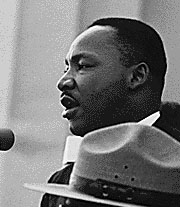
Remembering the Reverend Dr. Martin Luther King, Jr.

A hero, Martin Luther King, Jr. confronted death with courage: a saint, he enriched the souls of even his bitterest enemies. The same can be said of his Islamic alter ego, Malcolm X — Mr. X was less intentional about the second attribute, but he did do it, and toward the end, he was certainly coming around. But we are here to remember Martin — Malcolm has yet to have his day.

Of the life and times of Dr. King, we can read David Garrow's Bearing the Cross, of King's words, we can read his Testament of Hope. Rather than dwell on what can best be dwelt on elsewhere, I would like to reflect on how this man changed the face of racism in America during his short life, and how he served God.

A more-or-less overt racism used to be one of the "conversational cues" by which all good white people could tell that they shared a common set of values, and thus that they could associate safely with one another. In sociological terms, it was a sign that one shared the mythological self-understanding of the white tribe. "Of course, they live in their part of town, and we live in ours." Of course.

Now that same racism is a sign of stupidity, stubborness, and psychopathology. It is expressed only by those so low in the social strata, or so low in self-esteem, that they feel themselves to be beneath everyone except an imagined other.

White racism has changed from a fortified wall — you could get over it or around it, but they'd shoot you if they saw you — to a sea of jello: you can get through it, but the going is slow and difficult. Racism is gone from the really big things like voting, but it survives in the little things like getting stopped for DWB - Driving while Black, and the little things add up. Generally speaking, they still live in their part of town, and we still live in ours. Of course.

The little things, which when taken together often add up to economic things, were what Dr. King had begun to work on toward the end. That struggle continues to be waged today. The presence of a growing black middle class is evidence that it is being won.

The presence of black ghettos is evidence that for many, it is also being lost. The combination of race and class can still be dangerous — poor young black men are still more likely than members of any other group to wind up in the criminal justice system, and — more to the point — to die while in police custody. [Note added 2016: or at the hands of police - yes, Black Lives Matter.]

Nevertheless, a profound change for the better has been effected. In large part, it was effected by a single man, who despite his casual extramarital encounters, had proved himself to be the moral and intellectual superior of both his detractors and supporters. For Dr. King went where the Spirit led him, and did what he was led to do, even unto death, unto bearing the Cross. And he did it with a Shakespearean, a Biblical command of the language of all his people - black and white. Like Shakespeare and the Bible, his phrases ring in our hearts, "I have a dream," and "not by the color of their skin, but by the content of their character," and, "How long? Not long — because the arc of the moral Universe is long, but it bends toward justice." And in the end, "I may not get there with you, but I have seen the Promised Land!"

A hero, he confronted death with courage: a saint, he enriched the souls of even his bitterest enemies. We are all better off for his having been among us, for his having preached to us. Even those of us who were only children then, or who were not there at all, miss him.

07 November 1994

The Curse of the Blind Chihuahua

The Virtual Church of the Blind Chihuahua™ (VCBC), having no authority, power, or even existence beyond the virtual, reserves the right to curse those whom it deems necessary to punish for their bad behavior. Among these are abusers of religion, people, animals, and our environment, both real and virtual. As examples we curse terrorists, dictators, animal neglectors, litterbugs, malicious hackers, and spammers.

Our curse relies on the miracle of transubstantiation. As the Catholic Church asks God to change the spiritual "substance" of the Communion bread and wine into the Body and Blood of Christ, so do we beseech God to inflict a less palatable miracle of transubstantiation on those whom we curse. Let the last three drops of every swallow of liquid they drink be transubstantiated into the urine of the Blind Chihuahua for as long as they live, or until they repent.

Amen.

Some examples of those accursed:
  • Usama Bin Laden - for killing thousands in the name of his bastardization of Islam, and for convincing others to do likewise
  • Kim Jong Il - for making nuclear weapons and missiles the only viable economic activities in North Korea
  • Robert Mugabe - for starving Zimbabwe in the name of his personal amalgamation of Communism and Racism
  • Clerics who teach that democracy and/or science is incompatible with their religion - for loving power and control more than truth
  • Clerics who abuse their laity, whether physically, sexually, emotionally, or intellectually - for trading their relation to the Divine to do the work of its opposite
  • Laity who abuse their clergy without just cause - for punishing a clerics who don't meet the demands of their dark side
  • Anyone who persecutes people because of their ethnicity or religion - for dumbing down the definition of a human person to mean someone like themselves
  • Faith-based organizations who lend aid and comfort to those attempting the destruction of other faith-based organizations, such as the World Council of Churches and the Presbyterian Church USA (PCUSA).

06 November 1994

A Farewell to Arms Research

The beginning of the end of the National Laboratories?

Revised 1995 
As of 2007 Bell Labs is really most sincerely dead, the remaining employees (of what was once more than 20,000) belonging to Alcatel/Lucent, a French company. The name Bell Laboratories is retained as a marketing fiction.

And now, the National Laboratories (Los Alamos, Livermore, Sandia, Argonne, Brookhaven, etc.), have been privatized by an act of Congress. "We will make sure that this will not hurt these Jewels in the Crown of American R&D," say members of Congress, the DOE, and their staffs. Well, been there, heard that. It's bullshit. It's what they used to say about Bell Labs when they broke up AT&T. Which was swallowed and used to re-brand SBC, formerly known as Southwestern Bell.
If the National Laboratories helped win the Cold War, then where's our parade? — David Dearborn, 1992

The Republic has no use for scientists. — slogan at Antoine Lavoisier's trial in revolutionary Paris, 1794


The Jewel in the Crown


Bell Telephone Laboratories is dead. The Phoenix risen from its ashes is called AT&T Bell Laboratories, a new name for a new corporate culture distinguished by the short leash that now holds research in check. You see, research costs money, which is scarce now that AT&T is no longer a regulated monopoly with a guaranteed income from the "rate base," a term that indirectly meant you and me. So the management works harder to pick possible winners early on -- which means that it is better to do nothing than to do something that might be useless, which in turn means that most Bell Labs people don't do research anymore.

Moreover, Bell Labs isn't even managed by Bell Labs managers. Just two levels up from the working troops, or "Members of Technical Staff," the managers are listed as AT&T Network Operations or as Lucent Technologies. The top echelon of the Labs are essentially like old switching equipment that is too expensive to move when new equipment is installed — they are RIP, or "retired in place." But whether retired or active, all AT&T-BL managers embrace the new commandment: "Thou shalt have no other goals before the bottom line."

It was inevitable once the company was divested of its local telephone business. The changes make good business sense, and almost everyone at the Labs will tell you that what is happening there now is better than the chaos of the years just after 1984, when the break-up took place.
The problem is that the new Bell Labs now rarely tries the long shots, the revolutionary ideas that sometimes create whole new industries, because they are too great a short-term business risk. What was once described as one of the Crown Jewels of American Research has become just another industrial R&D lab. Which means emphasis on D — Development, and a back seat for Research. It's fine, really. It's just that everyone involved, including the government and AT&T senior management, said it wouldn't happen.

They were wrong. And the government is about to be wrong again. The government thinks that defense conversion in the form of small, short term projects won't hurt research at the National Laboratories.


The Hand that Rocks the CRADA


The Bell Labs conversion is part of a wholesale flight of American Industry from long term research that has been brought to you by changed economic conditions interacting with securities regulations favoring short term business strategy. We live in the "do it now" culture of immediacy. This originally business culture has pervaded government as well. Congress will "do it now" provided it is politically popular, as is defense conversion.

Now defense conversion of the National Laboratories is currently more like defense destruction, because they are told to "do it now" in the form of relatively small budget, short term Cooperative Research and Development Agreements (CRADAs), which paradoxically, the DOE seems to take forever to approve. A CRADA is a partnership between a private corporation and a National Laboratory in which the corporation and the DOE each put up half the money to pay for some quick D -- development, which results in a few months to a year or two, in some product or process for sale by the corporation.

The destruction comes about because the powers that be can delude themselves into thinking that CRADAs are a substitute for the long-term, stable, mission-oriented research that the National Labs do best. Each CRADA harvests the fruit of decades of research, without providing for planting and raising the next crop of ideas. In other words, if CRADAs become a major mission of the National Laboratories, they will be taken over by the culture of immediacy, of short term projects with a quick payoff, to the detriment of their present corporate culture that enables them to take on long-term, high-risk/high-reward, large-scale research on problems of national or global importance.
But then, there are no such problems, and big science is bad, right? Well, there's a lot of big science behind your telephone, behind the pharmaceuticals you take, behind attempts to cure AIDS and various genetic disorders. And behind all those CRADAs that will help our industry be a little more competitive, to the extent that competitiveness is a function of R&D rather than managerial competence.

To keep big science going at the National Laboratories, all it takes is a small set of clear missions, and some stable funding, which has to come, like it or not, from us taxpayers. What missions? I nominate human genome research, global change research, the old standby of defense research (including nuclear weapons research, unless you want America to get caught with its pants down some day), and real industrial research. Of course, that last one will require something our leadership fears to define — a national industrial research policy. Without such missions and such policy, the hand that rocks the CRADA may rule the laboratory. And that hand has no eye for the long term.


The Koehler Method of TQM


"Oooooof!" On wet grass at either end of a leash lay my wife and our Great Dane. You see, the Koehler Method1 of teaching your dog to pay attention to you is to put it on a long leash and just go. When the dog runs in a direction other than the one you're going, it gets yanked off its feet. Of course, if the grass is slippery, you take a fall, too. To a dog, this is leadership.
It's also the way our government sometimes leads the National Laboratories. Rather than engage in substantive discussion with the labs over missions and priorities, they just jerk the funding/regulatory leash. The current rules earmarking nuclear testing (if we ever test again at all) for only safety and security comprise one example. The endless inspections of minute details of lab procedures are another — as of this writing, inspectors are planning to check (among other things) that the word "SECRET" stamped on so many of our documents is exactly the correct size. And now we are being asked to re-invent ourselves.

Total Quality Management (TQM) is coming to the United States' last bastions of long-term, large-scale, mission-oriented research. It could be marvellous. But if it is abused, there will be performance measures for everything, each one giving ignorant bureaucrats the illusion that they can manage what they do not understand. As one wag remarked, "TQM is the revenge of the 'C' students."
The upshot of this is that employees who maximize the measures of their performance may often fare better than the ones who do good science. Those who comply with the leash may dominate those who try to figure out which way to go. That's fine for dogs, who know less than their masters, but sometimes scientists really do have something to say about how to do science. Though the TQM slogan, "the customer defines quality," is tautological in the short term, it could be disastrous in the long term if the customer (the DOE), through willful ignorance and blind distrust, gets out of touch with reality.


Favorite Sins


I heard an anecdote once about a Russian couple who, tired of city life, moved to a rural area just outside Moscow and bought a goat, which got poisoned soon afterward. Their neighbors had chickens, rabbits, and ducks, but no goats. Such an obvious sign of extraordinary wealth was not to be tolerated, because it made everyone else look bad. Besides, who did these transplanted city-dwellers think they were?

In the same vein, Russian entrepreneurs get their businesses raided and subjected to harrassment by the KGB. There was even a television news story recently about an independent farmer who, with twenty or so employees, out-produced a nearby collective farm with a staff of 2000. The collective farmers, who were on the town council, simply revoked his lease on the land and put him out of business.

The common theme in these examples is Russia's apparently favorite cultural sin -- envy. Rather than to create wealth, they just make sure that no one gets more than anybody else. It's no wonder that Communism took root so easily there. Now Russia is a poor country, and will remain so until its people pass beyond Envy — perhaps to our favorite cultural sin of greed.

On the other hand, we're more envious and less greedy than many of us would like to think. We have a business culture in which competetive strategy sometimes means screwing our opposition rather than doing a better job. Hence the occasional flurry of lawsuits, frivolous and otherwise, over restraint of trade. One can even imagine a company suing to prevent another from entering into a CRADA with a National Laboratory. The plaintiff isn't seeking to be included in the enterprise, just to keep the competition from participating.

As the saying goes, there ought to be a law against that sort of thing. You see, CRADAs are a poor way to sustain long term research, but they're a great way of capitalizing on it. As such, they should be protected.

And so should the scientists and engineers working on them. God help the National Laboratory scientist/engineer with enough entrepreneurial spirit to turn a CRADA or an invention into a business. Though we are trying to help our nation create jobs, we are not allowed to profit personally from our researches. This encourages the entrepreneurial researchers to take jobs elsewhere, which hampers the National Laboratories' efforts to help entrepreneurs.

So my current vision of a National Laboratory flanked by tens of small and large businesses founded by former Laboratory researchers, who still maintain close ties to the Laboratory, is currently illegal. As we re-invent our government, maybe we can fix that.


Paradigms Lost


Gathering the various threads at this point, we see that the National Laboratories are being jerked around by short-term thinking, without clear long-term national policy to guide them, or a even legal foundation encouraging them to respond well to the short-term pressures. Add to that declining budgets, which, in the absence of a clear mission, will incite turf-battles among the managers in which skill at self-promotion and compliance to the leash-holders will determine success, rather than the scientific merit. What we have here is a recipe for organizational decline.

Now the end of the Cold War was a very big thing, but by itself, not big enough to do all this. There's something else going on. It's all over the back pages of Physics Today , where the job listings are. Or rather were. Judging by the scarcity of "permanent" positions advertised, now is the worst time in this century to be a physicist.

It's not because our culture is obtuse, buying into the idea promulgated by otherwise well-educated people, such as Vaclav Havel, that science is immoral. It's not even because the public has replaced the undeserved faith it once had in science with an equally undeserved skepticism. It's because the paradigms that have sustained twentieth century physics may be, in a strictly technological sense, played out.

Take classical electromagnetism, for example. Radio, radar, telephony, satellite communications, fiber optics, etc., have already been invented and well studied. The consequences of classical electromagnetic theory are well explored. Further advances in the technology require engineering rather than physics.

The same can be said for classical mechanics, despite the recent breakthrough in our understanding of complex systems represented by chaos theory. Basically, we know how to build machines and fly rockets. Case closed.

Special relativity and quantum mechanics gave us nuclear weapons and some interesting accelerator-based cancer treatments, but again further technological advances in those areas no longer require theorists.

Areas do lie waiting to be explored in quantum field theory, such as superconductivity, but that is more a matter for the alchemist-like experimental approach of materials science. And the real frontiers, Grand Unified Theories (GUTs), superstrings, and the like, lie far beyond our present technology to explore.

So that's it. Twentieth century physics, for good and ill, has delivered on most of its promises. Physics as we know it probably has no more wonderful or terrible technological implications, beyond what it's already given us. The remaining triumphs will be small for the next decade or two, like scanning-tunnelling and surface-force microscopy -- applications of physics that make it possible for other sciences to advance. And though the big breakthrough into the next paradigm may be only a few well-thought ideas away (some of which I may have sketched elsewhere), none of us can quite imagine it now.

Is it unreasonable to expect, then, that our corporate and national investments would shift from the physical to the biological sciences, where the paradigms are fresh, the promises great, and the technology ripe to explore them? Is it such a bad thing that people just want to live better, longer, and more cheaply? The shift in investment is hard on physical scientists like me, but ultimately I have to applaud it. I want to live better, too. I just want people to remember that many of the tools used by the life scientists were invented by physical scientists, and that we need to maintian some level of investment in the physical sciences if we want better tools to keep coming.


Another Physicist on Madison Avenue


So the lab is on a short leash, defense budgets are declining, the general economy is in a rut, and the economy for physicists is unlikely to recover in my professional lifetime. Retirement is beyond my planning horizon, and my literary agent tells me to keep my day job. Well, it's no use waiting around to see if the axe will actually fall. It's time to consider how to sell my time again, to whom, and for what purpose.

I could use my work in fluid turbulence as a lever to pry my way into the global climate research group, and remain halfway in the weapons program -- global climate modeling is being partly funded as a way to diversify weapons research into more peaceful "dual-use" activities.2 But that bubble could burst if the improved simulations throw cold water on the global warming hypothesis, or if the movement to consolidate government-funded research gathers too much steam. I could try to work my way further into the Inertial Confinement Fusion program, but its future looks uncertain to me, too.3 I could continue studying nuclear explosives in hope of becoming tenured as a person vital to our national defense. But for my generation such tenure may be reserved only for those who have tested their own nuclear explosive designs — in a severe budget crunch the more theoretical nuclear weapons physicists like me would have to be considered expendable.4 Moreover, that tenure will exist only as long as the American people want it to. Even though there are good arguments for maintaining a state-of-the-art thermonuclear weapons design capability at both Los Alamos and Lawrence Livermore National Laboratories (some of which are presented elsewhere5), there are no guarantees.

So, maybe it's time to work the other side of the same street (or if the human propensity for war can be compared to a large carnivore, to switch teats of the tiger). Instead of contributing to nuclear deterrence, I think I'll try counter-proliferation. The Saddam Husseins of this world are doing their best to make it a growing business. Which for me means farewell again, theoretical physics. The weapons program still needs it, but it will be the first to go if funding gets much tighter. Hello again, systems engineering. I just hope the johns are as good to work for.6

Now my departure represents a small loss to the weapons program, because it has other physicists who could take up my work where I'm leaving it off. Unfortunately, that is less true for some others who have left the program ahead of me. While we work to make sure the former-Soviet nuclear weapons scientists have a future through such efforts as the International Science and Technology Center, we might think about making a future for our own. And for those of you who are unconcerned that the US nuclear weapons research program may be disintegrating, the words of Ghostbusters — if you wind up needing us after we've gone, "Who ya gonna call?"


Notes

  1. For more details on how to make a large organization comply to your commands, see William Koehler's, The Koehler Method of Dog Training, Macmillan, New York, 1962.
  2. The nuclear weapons design physics program is slowly diversifying into other fields in order to provide interesting and useful work for the people it needs to maintain sufficient competence in the various areas of nuclear design necessary to continue stewardship of the US nuclear weapons stockpile. As long as the US government considers that stewardship to be necessary, there will be no effort to "convert" the relatively small physics portions of the nuclear weapons program to civilian endeavors. The diversification of the physics parts of the program is proceeding slowly, because any new work must be synergistic with the program's core mission, and beause its management is as yet relatively inexperienced at the kind of business planning that such diversification requires. The much larger engineering portions of the program, which are not responsible for stockpile stewardship, are converting rapidly.
  3. For two reasons. (1) The ICF program is run on a short leash and is subject to cut-back or cancellation at any of several Key Decision Points as determined by a select panel of scientific rewiewers (the ICF Advisory Committee, or ICFAC), and/or by a budget-conscious government. I'm concerned that I could join the program only to end up like the scientists who worked until recently on the now-cancelled SSC. (2) I wonder if anyone has really worked through the engineering economics of ICF. Even if ICF can be made to work from a physics standpoint, ICF plants might have to be so big (and so costly) to be cost-effective that no electric power company could afford to build enough to take up the slack when any one plant is taken off line for maintenance. It may be more likely that ICF will be used to generate synthetic fuels rather than commercial electric power.
  4. I spent most of my "designer" days working on non-explosive parts of now-shelved concepts that were the opposite of the "neutron bomb" in that their use would have done much more harm to selected "assets" than to living things (an example of how a peaceful gesture — the current US "no new nuclear weapons" policy — might not necessarily make the world safer). Since then I have concentrated on theoretical work aimed at refining some aspects of our capability to predict thermonuclear explosive performance via computer modeling. And no, I can't build a bomb. If I could, I wouldn't be publishing this stuff.
  5. See "Obscenity and Peace" at this site.
  6. The title of this section refers to Tony Rothman's A Physicist on Madison Avenue, Princeton University Press, 1991.

Young Love

Love is the most fun you can have without laughing. - Anonymous
When I was in junior high I realized, after the initial rebuffs, that it was going to be years — an eternity to a thirteen year old — before I got laid. When I got old I would have a son, and I would tell him what I went through, so that it might go a little better for him. I even kept a diary. Now I'm not your father, and you're not my son. My diary I'll keep to myself. In its place I substitute my thirtysomething thoughts on my teenaged days.

As a teenager I was a human becoming more than a human being. This fact, this launching of myself toward adulthood, conditioned all my relationships, intense or casual. Falling in love under those conditions was like trying to move into an apartment in a skyscraper before the floors were poured — lots of pitfalls and construction noise. In choosing a girlfriend I was choosing a self to try to be — developing a sense of self that was genuine because it was mine, rather than my parents'. I was also measuring my self-worth — seeing what kind of girl I could trade myself for. With the young ladies' help I was doing the urgent and creative work that all teenagers must do — I was creating me. And I loved whom I wanted or needed my girlfriends to be more than who they were, or were becoming. Those who did not reject me reciprocated in kind.

Thus my first criticism of high-school romance: the emotions are intense because the hormone levels are high and the psychological needs are great, but real intimacy under such circumstances is nearly impossible. And my first praise of it: by finding out how difficult it is to achieve intimacy, I came to value it and to understand what I was willing (and unwilling) to sacrifice for it.

Besides love, intimacy, and a sense of self, high school romance is largely about sex, whether or not the desire is acted upon. In my experience of this phenomenon (through my own escapades or those of my friends and acquaintances) we used our sexuality to experiment with new behaviors (Did you get to first base?), to assert our emotional independence from our parents (What's the matter, are you afraid?), to gain social status (He can't be a fag — he's dating someone!), and self-confidence (Whatever she wants, I can handle it.).

All of this emotional loading may heighten the intensity of sexuality but tends to diminish its other qualities, an idea which may be lost on adolescents, who rarely appreciate that sexuality has dimensions other than intensity. The quest for intensity often leads teenagers into relationships that are emotionally — and occasionally physically — abusive. There is nothing quite like "first love," especially when one is in love with a beautiful or handsome emotional roller coaster jockey.

And what if despite all odds, the teenager makes some fleeting contact with the real person, the "inner child" of the other? Sometimes one finds the love of one's life. My relationships followed the far more usual course, ending because we were growing teenagers who grew apart. And then, because I had been changing so fast at that age, there was no normal state of being for me to return to. I couldn't go back to being the old me, because the old me was a kid. In that sense, I never "got over" my teenage romances. I just moved on after a couple of years, when I realized that the state I was in was as normal as I was going to get.

I don't know what of this you might say to your teenagers, in addition to the usual drug, pregnancy, and venereal disease information. Maybe that, despite the message of popular culture, they might look to God for the affirming love they often seek from each other. Maybe just that it might do them more good to look for a close friend rather than a lover. But teenagers tend to talk more than they listen, and to do risky things because they need to prove themselves and because they're too young to appreciate how risky they are. That's why they're used as soldiers.

Oh, well. As Jimmy Durante used to say, "God bless you, Mrs. Calabash, wherever you are." Or was it just "Good night?"

A Soldier's Story

I mean, you want to know if I'm moral enough to join your army, to burn women, kids, houses, and villages, after bein' a litterbug? — Arlo Guthrie, "Alice's Restaurant"
This is what happened to Russ in Vietnam. On R&R in Saigon, he and a beautiful Vietnamese woman fell desperately, and secretly, in love. After the madness was over, they would come to America and make a life for themselves. But for now, they would meet furtively, rarely, briefly. Nobody who knew either of them could know about both, because her brother was Vietcong. Technically, they were each sleeping with the enemy.

And then, at their meeting place, she didn't show.

"That one?" said one of his buddies casually, "They say she was killed by a mine two weeks ago."
The feeling of a kick in the stomach, the taste of acid on the tongue. And he had to hide it, to stay a soldier.

"Here today, gone tomorrow," he shrugged, feeling suddenly like a traitor -- not to his country, but to her memory and to himself. But if he shared his grief with his buddies, they would say it was to his country, and he would be dishonorably discharged, at best. So he fought on, silenced about what was becoming an incurable wound.

Funny. Here he was depending for his life at times on people he couldn't trust. And ready to give his all for those who would turn on him if they only knew.

When he got stateside, he didn't try to replace the love he'd lost. The singles bar scene was all he wanted, and he went for it with abandon. Alcohol and casual sex were his anesthetics for a while. Eventually he gave them up, left the service, and settled down to a wife and a tolerable job. And though he looked good on the outside, he had two constant companions that were slowly killing him. One was depression, and the other was the virus he'd picked up during one of those dates after the war.

The story of Russ (not his real name) is true, mostly. Except that his lover was not the enemy. His lover was an American pilot who got his name put on the big, black wall in Washington for giving "that last full measure of devotion" while flying a combat mission in Vietnam.

So, when I think of the people who oppose liberalizing the US military's position on gay and lesbian soldiers, I think of Russ and how he suffered under that policy. I think about the statistics on homosexuality, and how they imply that, along with that of Russ' lover, the names of as many as a thousand homosexuals may be written on the Vietnam War Memorial.

Those homosexual soldiers fought, slept, ate, showered, and died as heroes alongside heterosexual soldiers. They knew how to handle themselves in all those situations. Their heterosexual buddies did not, forcing them to keep their secret, most of them to the grave.

Now we Americans are concerned about the effect of gay and lesbian soldiers on military morale and discipline. But a thousand names carved in stone say that's not a gay soldier's problem. It's a straight soldier's problem. People are concerned because that is the nature of homophobia — homophobia occurs when straights who have problems with gays try to make gays solve those problems for them — even if it's just by keeping their homosexuality a secret. A thousand names say the concern is based on mythology believed by straights who don't think they know any gay people.

Except for the concern about how the straight soldiers will behave. On the other hand, gay bashing is another form of sexual harassment, an area that the military needs to deal with anyway, as shown by the Tailhook scandal.

So, I think we should move forward on the legalization of gay and lesbian soldiers. Doing so will take courage and self-discipline, and a sense of security in our own sexuality. It will take, as a soldier might put it, "balls."

03 November 1994

Church of the Self-Satisfied

I wrote this while attending a church that was ejecting its pastor. A case of the congregation abusing its clergy.


Greetings to you in the name of the Lord!
We Crucifiers meet each Sunday to lie about Jesus.
The sermon slides off our collective self-image into the cup
to be consumed with the body and blood of our Victim,
and so to pass through, changed by us, not us by them.
Greetings to you in the name of the Lord!

The Peace of the Lord to you!
A smile, a handshake, a Judas kiss.
Pieces of silver collected for service to our Values —
nothing special, just nothing different —
we come to be comfortable, above all.
The Peace of the Lord to you!

Visitors Welcome. Join us soon.

02 November 1994

Apocalypses Now


Nuclear war, overpopulation, global eco-catastrophe, asteroid impacts, exhaustion of the sun, the final crunch, rip, or heat-death of the universe. Science holds that ultimately, we are doomed. Christian Fundamentalists seem to gloat, judging from the apocalyptic "literature" in bookstores. But "eco-guilt" and religious end-game fantasists1 may be in for a disappointment. The end may be rather dull. Here are some possible scenarios.

See/hear also REM's TEOTWAWKI


Coyotes, Mosquitoes and Rats, Oh My!

Mr. Speaker, I smell a rat. I see him floating in the air. But mark me, sir, I will nip him in the bud. — Boyle Roche: Speech in the Irish Parliament, c. 1790

Every now and then I read in some magazine (most recently Natural History at the optometrist's office) about a wonderfully adaptable species that has managed to thrive despite the onslaught of human numbers. This time it was about the coyote;, an adaptable predator that, it turns out, doesn't kill cattle, but takes smaller prey. It seems that coyotes have made a determined comeback in the west, and have now spread east into Vermont and New Hampshire, with the eastern coyotes being noticeably bigger than their western cousins.

Why go east, young dog? Lured by the call of the tamed? Nobody knows yet, but it is certain that the coyotes are not moving into the ecological niche left by wolves. The wolves disappeared from most of this country because their niche disappeared -- moose, deer, and other large game lost their habitat to farmland, and were hunted heavily besides. No forests, no game, no wolves.

No, the coyotes are moving into a new niche, one created by us. They eat the discarded carcasses of the 10% or so of calves that don't make it every spring at dairy farms and cattle ranches. (The ranchers take the dead meat out to the back forty and dump it. The coyotes just couldn't leave it to rot.) They also eat rabbits, squirrels, mice, voles, and the occasional domestic cat. In addition, coyotes have learned to use abandoned cars as dens, and to trot calmly along the sides of major highways.

Now human overpopulation, pollution, deforestation, and plain old inefficient land use are causing species to go extinct as fast as they did when the dinosaurs vanished. We are becoming a force of "natural selection" as powerful as an Ice Age. At this rate, only those species that adapt themselves to us, like coyotes, will survive. On the other hand, those that adapt themselves to us like pigeons, cockroaches, lice, and rats; will thrive. And in a world in which parasitism of human civilization is the only key to survival, God forbid that any of these parasites should become intelligent!

My fear is not that we may destroy all life on this planet. I'm afraid that we're turning the entire natural world into the equivalent of a giant smart rat, who can't wait to figure out new ways to get us. Imagine a picnic in a really hostile environment -- no big, dangerous things, just little annoying ones like clever mosquitoes who always bite in well-coordinated teams and who've learned to love insect repellent. Everywhere you go there will be a myriad creatures absolutely delighted to see you!

But so far it's still a wonderful world out there, with all sorts of intricate life and death struggles going on that we're not part of. Let's keep it that way. Let's leave more of it alone.

Birth of a Species

And they shall no more teach one another saying, know the Lord: for they shall all know me... —Jeremiah 31:34

Imagine the consternation of Oog and his fellow early modern humans at the strange new behavior of their teenagers. They no longer give a good old fashioned threat scream before a status or mating fight. They make little noises among themselves, and then act as a group, overcoming even the strongest Old Ones. The old ways are forgotten, the old order destroyed. It is the end of the world. Or at least it may have seemed to be the end of the world to the early humans, when some small group first started speaking true language;.

Much later, when the wasichus overran North America and displaced the original inhabitants, the world ended for many Native American tribes. They measured their humanity by adherence to their cultural values (some of which were nice, some of which were nasty -- they were neither more nor less saintly a people than anyone else). Thus when their cultures died, they believed there would be no more real people left on earth.

Now human culture seems pretty well entrenched. What could possibly make it die without tremendous upheaval? A change in perception, perhaps? Remember Oog?

Elsewhere I have conjectured that there may be more to the mind than the brain, and that some of our (un)consciousness may reside in patterns imposed directly on the quantum (gravitational and other) vacuum oscillations of the "empty" spacetime within and around us. If that were true it might be possible for some of us to learn to perceive or communicate via these oscillations -- which might amount to something like so-called telepathy. If such telepathy became the preferred mode of communication among a group of people, and if the talent for it were inherited, it could provide the basis for what would at first be a sub-culture of people for whom ordinary language might be lost. Eventually, since communication plays an important role in human relationships, and therefore in human reproduction, such an ability could provide the basis for the division of humanity into distinct subspecies -- the telepathers and the talkers. If the telepathers had enough other abilities going for them, or if telepathy enabled them to outwit us sufficiently, they might eventually supplant us talkers. But rather than build on our historical achievements, they would start over, because our history would be irrelevant and incomprehensible to them. The new Adams and Eves would begin as a tribal community, not knowing where they came from, and perhaps never discovering who we were. Rather than being a glorified version of ourselves, the Superior Race would be completely alien to us.

It wouldn't be the end of the world. Just the end of our world. Of course, once a new door of perception is opened, who knows what may enter -- a more direct awareness of God, perhaps? Don't panic, it's only a scenario and a ridiculously far-fetched one at that (I don't actually believe in telepathy -- but so many science-fiction writers speculate about it, that it's hard for me to resist). The point is that the extinction of our species, just like our own individual deaths, may come in a manner and at a time other than we expect.

But then, life is like marriage - you get into it for how it is, rather than how it ends.

That White-Hot Morning, Revisited

Everything that is done in the world is done by hope. — Martin Luther, 1569

It looks like dawn, but the sun comes in the wrong direction, blinding bright, flashing the wallpaper opposite the window into flame. Your heart sinks, you grab your loved ones and dash for that protected closet. As you close the door the blast wave hits, a sound so loud it's more like silence. The building leans and shudders, the beams crack, and then tense stillness, waiting. Suddenly the walls reverse their lean, shaking under the impact of flying debris. Again stillness, except for beams groaning as the building settles. You open the door to thick dust clouds, which clear to reveal torn roof and walls, empty window frames, broken crockery, shredded books, smashed furniture. The power is out, the phone is dead. You find your portable radio, miraculously in working order, but no one is broadcasting. You search the rubble for some blankets, which you find smeared with blood -- yours. Just a cut on your hand from broken glass, but you know how you're going to die now. Weakened by hunger, thirst, and radiation sickness, and without antibiotics, you're going to die of infection.

Impossibly, the phone rings. You pick up the receiver, but your tongue is so thick you can't speak. The voice on the other end says, "This dream has been brought to you by Nuclear Nightmares, Incorporated. It's TIME to wake UP."

Fairly accurate effects, I thought. Just like they taught us in the Nuclear Weapons Orientation Advanced Course. The NWOA is a week long training session conducted by members of the Armed Forces for a number of organizations. At my National Laboratory, it is part of the orientation program for new employees. The lectures on Blast and Thermal Effects ("The Shake 'n' Bake Lecture") and Medical Effects were given to us by a Marine who seemed to evaluate his effectiveness by the dent he made in the cafeteria's business that day. So the concerned public needn't tell us about nuclear weapons effects. We know, even those of us who didn't write the book on them.2 Nuclear world war, if we have one, will make movies like "The Day After" and "Testament" look like a party. Even "Threads" will seem mild. Our species will probably survive, but our culture won't -- it's too complicated to be maintained by people with short lifespans.

As it says in the dream, it's time to wake up. Passivity just encourages bullies, while aggressiveness encourages us to become bullies ourselves. It's time to use our relationships to enfranchise and empower others, and to be assertive in deterring them from abusing us, should they try. It's time to include everyone in "us" rather than to pretend that some of us are "them." It's time to use our religions to open ourselves to God rather than to close ourselves to each other. It's time to engage in management as a human enterprise rather than a dominance/submission ritual. It's time to trust what little we know and yet to admit how little it is, and to open ourselves to the new. It's time to turn from making war on war to making peace. Or else time will run out for us sooner rather than later, whether or not I do research related to weapons which, thus far, are only a reflection of ourselves.


Notes

  1. I think the apocalyptic tradition in the Bible is provided for us to take comfort in tough times, rather than for us to treat as some sort of sorcery for making specific predictions of the future (an activity which Scripture condemns).
  2. The Effects of Nuclear Weapons, 3rd edition, edited by Samuel P. Glasstone and Philip J. Dolan, US DOE and DOD, Washington, DC, 1977.

Abducted in their Dreams

We are such stuff as dreams are made on. — William Shakespeare,The Tempest, 1611
In the middle of the night you find yourself paralyzed, lifted into a spaceship, and probed. You hear voices inside your head. The next thing you know, you are back in your car or bed, hours missing from your memory. Under hypnosis you recall fragmentary experiences, as if from a dream. You have had (if UFO abduction experiencers can be believed) a close encounter of the fourth kind.

Now I doubt such reports, because I doubt aliens could or would want to find a small needle like us in our enormous galactic haystack. But let's play Star Trek for a moment. Suppose aliens have found us, and have bridged the communication barrier natural to beings evolved on different worlds. Then we must ask why these encounters are the way they are — which is like our dreams.

Our dreaming consciousness has many of the attributes of a close encounter all by itself. Active brain mechanisms suppress movement and memory — otherwise we would all sleepwalk and recall dreaming ninety minutes each night. Though language occurs frequently in dreams, we rarely remember details of what is said or written. Our dreams shift from one paradox to another, as if we had no sustained attention span and little contact with reality. We enter a state of consciousness that Freud thought similar to a hypnotic trance (which may be why hypnosis can help us remember dreams), and which some modern researchers think similar to schizophrenia — that is, schizophrenia's characteristic hallucinations may be waking dreams.

Since dreams are so much like close encounters, perhaps the aliens deliberately induce a dreamlike state of consciousness in their abductees. That way they can interact meaningfully with semi-conscious individuals while using humans' natural dream mechanisms for suppressing movement and memory. This may allow them to cautiously study humans before "coming out" to us as a whole. But why so many encounters, and why don't they cover their tracks better?

Consider that UFO experiencers frequently report some kind of "telepathic" communication with their captors. Perhaps the mental state in which humans are most capable of telepathy happens to be the one in which we dream. Maybe the aliens induce this state in humans so as to facilitate communication, or maybe the dreamlike state is a simply a byproduct of their attempts at telepathy. If the aliens don't have dreams themselves, they may not realize that they are impairing humans' normal functioning. They may even think that humans reflexively become paralyzed, forgetful, and crazy whenever we experience anything new. Perhaps they repeat the same encounter many times with particular individuals hoping that some humans might get used it and react less strongly. Too bad their way of talking to us seems literally to put us to sleep.

Maybe the aliens try different experiments to find out what's going wrong. Though they keep trying to communicate we forget all about it, or act as if our encounters were unreal when we remember them, because dreamlike experiences don't connect with the world we know in our waking state. On their part, if the aliens are naturally telepathic, they may think all intelligent species are, and that contacting one human contacts us all. Perhaps they wonder why we don't get the message. So if you're a repeated UFO experiencer, try to remember to tell them (it's called lucid dreaming by sleep researchers) that if they're trying to communicate, they're blowing it. Tell them to write, instead.
Of course, the simplest and, to my mind, most likely explanation is that UFO abduction experiences aren't merely like dreams, they are dreams. Still, you never know.

Editor's Note:  See for example Passpost to the Cosmos - Human Transformation and Alien Encounters and/or Abduction, by the late John E. Mack, M. D.